
A government department can determine whether a family can keep a roof over its head using calculations that nobody can adequately explain, assumptions nobody appears willing to own, and operational policies that seem to exist somewhere between legislation and imagination.
Nobody can explain it.
Not Treasury.
Not MSD.
Not the review committee.
Not the Ministry.
Ask how they determine whether someone is in hardship and you get a formula.
Ask who designed the formula and you get "operational policy".
Ask who validated the assumptions and the room suddenly becomes very quiet.
We live in a country where financial advisers need qualifications.
Accountants need qualifications.
Lenders need qualifications.
Banks must follow financial standards.
Government departments, it would appear, simply need a calculator and the word "operational".
Act I: Request a Review
It begins innocently enough.
You disagree with a decision.
You ask for a review.
No problem.
The Ministry assembles:
- Two MSD representatives
- One community representative
- You
A perfectly balanced process involving 75% MSD representation reviewing an MSD decision made by MSD.
Naturally.
When asked whether any of the reviewers have legal qualifications or financial qualifications relevant to the decision being reviewed, the answer is largely irrelevant because the review is based on "the policy."
Next question.
Act II: Ask the Minister
Perhaps the Minister can explain it.
After all, Ministers are responsible for the portfolio.
A letter is sent.
The response arrives.
The matter is operational.
Not ministerial.
Not policy.
Not governance.
Operational.
The Minister disappears through a cloud of administrative smoke.
Act III: Officially Request Information
Surely the assumptions must be documented somewhere.
An Official Information Act request is submitted.
Models requested.
Calculations requested.
Assumptions requested.
Validation requested.
The OIA that arrived quickly.
A small crack did appear in the wall.
Remarkably, one Official Information Act request was answered quickly by the Ministry of Health via the Minister of Health.
The question concerned downstream impacts.
Apparently that answer was not difficult to find.
After all, it hardly requires a Nobel Prize in economics to conclude that when people lose access to things like Community Services Cards, some stop visiting their GP because the cost can consume a significant portion of a week's income.
When primary healthcare becomes unaffordable, people do not become healthier.
They simply show up later and sicker somewhere else.
Usually somewhere considerably more expensive.
One begins to wonder whether the modelling doesn't exist, cannot be found, or simply leads to answers nobody particularly wants to discuss.
The OIA on Hold
Meanwhile from MSD and the Minster holding the portfolio for the Ministry of Social Development. The strategy appears to be to hold out long enough to change portfolios or the election to arrive first
Delay.
Extension.
Consultation.
Transfer.
Clarification.
Further delay.
At some point the requester begins to suspect the modelling is being generated by a single intern armed with a spreadsheet and a stress ball.
Act IV: Ask About Financial Capability
A simple question:
MSD performs means testing.
MSD assesses hardship.
MSD assesses assets.
MSD assesses affordability.
MSD assesses housing costs.
MSD assesses what people can and cannot afford.
Do MSD staff require financial qualifications?
Answer:
No.
They use the Act.
Interestingly, the Act itself appears remarkably free of many of the formulas and assumptions used operationally.
But apparently the formulas emerge from somewhere.
Operationally.

Act V: Ask Treasury
Perhaps Treasury understands the framework.
After all, if anyone in government understands financial governance, surely it is Treasury.
The people who worry about:
- fiscal sustainability,
- financial reporting,
- Crown accounts,
- cost pressures,
- modelling,
- assumptions,
- forecasts,
- and whether the numbers actually make sense.
Surely somebody there can explain how a government department performs financial means testing, assesses hardship, evaluates assets, determines affordability, and measures financial need.
A letter is sent.
The response arrives.
That is an MSD operational matter.
Translation:
"Not our circus. Not our spreadsheet."
An interesting response.
Because if Treasury doesn't know what standards MSD applies when making financial decisions...
And MSD says it follows operational policy...
And the Minister says operational decisions are MSD's responsibility...
Then who exactly is responsible?
Apparently nobody.
Which is quite an achievement when the decisions directly affect housing, hardship, debt, and financial stability.
The public is assured there is governance.
The governance is assured there is policy.
The policy is assured there is a formula.
The formula is assured there is a calculator.
And somewhere in between, accountability quietly leaves through the fire exit.
Treasury exits stage left.
Intermission: The Magic Trick
The truly remarkable thing about the Financial Wizard is not the calculator.
A calculator is simple.
A two-year-old can operate a calculator.
The remarkable thing is that once a calculator is combined with an Act, an operational policy, and an unexplained formula, it somehow becomes capable of making financial assessments without any requirement to understand finance.
Need liquidity assessed?
Calculator.
Need asset availability assessed?
Calculator.
Need hardship assessed?
Calculator.
Need housing affordability assessed?
Calculator.
Need downstream impacts assessed?
Well, now you're asking difficult questions.
Because somewhere between the legislation and the operational policy, the calculator transforms into a magical financial oracle.
Not because it understands financial documents.
Not because it understands hardship.
Not because it understands mortgage structures.
Not because it understands risk.
But because the formula says so.
Act VI: The Success Loop
People receive insufficient support.
Hardship increases.
Debt increases.
Stress increases.
Applications increase.
Reviews increase.
Complaints increase.
Administrative workload increases.
The Ministry requires more resources.
The additional resources create additional compliance activities.
Additional compliance activities create additional reasons to decline assistance.
The machine begins feeding itself.
A truly sustainable ecosystem.
Act VII: The Last Resort
MSD often describes itself as the "last resort."
Think about that for a moment.
The last resort.
What exactly comes before it?
The bank has already said no.
The hardship application has already been made.
The savings are gone.
The assets are being sold.
The family is already cutting costs.
The bills are already late.
Bank of Mum and Dad doesn't exist.
What remains?
Loan sharks?
Leaving the country?
Sleeping in a car?
Living in a garage?
Homelessness?
Nobody ever seems able to answer this question.
MSD says it is the last resort.
Then declines assistance.
The assumption appears to be that another option must magically appear.
Somehow.
Somewhere.
Preferably without disturbing the operational formula.
And when the person eventually falls through the cracks?
When the debt increases?
When the housing becomes unstable?
When the hardship becomes real?
Nobody returns to check the assumptions.
Nobody reviews the model.
Nobody audits the formula.
Nobody asks whether the machine itself is producing the wrong outcomes.
Because the machine got an answer.
The answer must therefore be correct.
Act VIII: The Uncomfortable Question
Historically, governments learned a painful lesson.
Hungry people do not simply disappear because a ledger says they should.
It was once common for people to be transported from Britain for crimes as trivial as stealing bread.
Eventually society realised the problem was never the bread.
The problem was the conditions that made stealing it appear to be the only option.
Today we like to believe we are more sophisticated.
But are we?
When MSD describes itself as the "last resort" and then refuses assistance, what exactly is supposed to happen next?
Not in the spreadsheet.
Not in the model.
Not in the operational policy.
In reality.
Because reality has an irritating habit of continuing long after the assessment is complete.
People still need to eat.
People still need somewhere to sleep.
People still need to keep the lights on.
People still need to survive.
Australia has made it abundantly clear it won't be taking New Zealand's unwanted poor. Recent experience suggests it would be perfectly happy to return a few.
So where exactly are people supposed to go?
And before anyone answers "somewhere else", it is worth remembering that "somewhere else" is not a policy.
It is an assumption.
An assumption that somebody, somewhere, will absorb the consequences of a system that has decided not to.
Which raises an even more uncomfortable question.
The Social Security Act exists for a reason.
Near the beginning, it sets out the purpose of providing support to people in need and helping New Zealanders maintain dignity and stability in times of hardship.
So if the agency responsible for administering that support is failing to achieve that purpose, who is responsible?
The Minister says it is operational.
Treasury says it is operational.
MSD says it follows policy.
The review committee says it follows the formula.
The formula says the answer is correct. Governance, apparently, has left the conversation.
The truly uncomfortable question is not whether the formula produced an answer.
The uncomfortable question is who is accountable when the answer is wrong.
Because when hardship increases, debt increases, housing becomes unstable, and homelessness becomes a realistic outcome, nobody returns to check the assumptions.
Nobody reviews the downstream effects.
Nobody asks whether the machine is producing outcomes consistent with the purpose it was designed to serve.
The formula produced an answer.
The file was closed.
The spreadsheet balanced.
The consequences, however, remain stubbornly unbalanced.
And somehow that part is always classified as operational.
Act IX: The Financial Wizard
Nothing delights MSD quite like making financial decisions.
Not because MSD employs financial advisers.
Not because MSD employs mortgage specialists.
Not because MSD follows recognised financial standards.
But because MSD has a calculator.
The process is remarkably simple.
Step 1: Count income.
Step 2: Decide which expenses exist.
Step 3: Insert formula.
Step 4: Declare reality.
Need to know how shares should be valued?
Your responsibility.
Need to know how shares should be sold?
Your responsibility.
Need to know how liquidity works?
Your responsibility.
Need to know why certain liabilities count and others don't?
Operational.
Need to know who designed the assumptions?
Operational.
Need to know who validated them?
Operational.
Need to know who is accountable when they are wrong?
Operational.
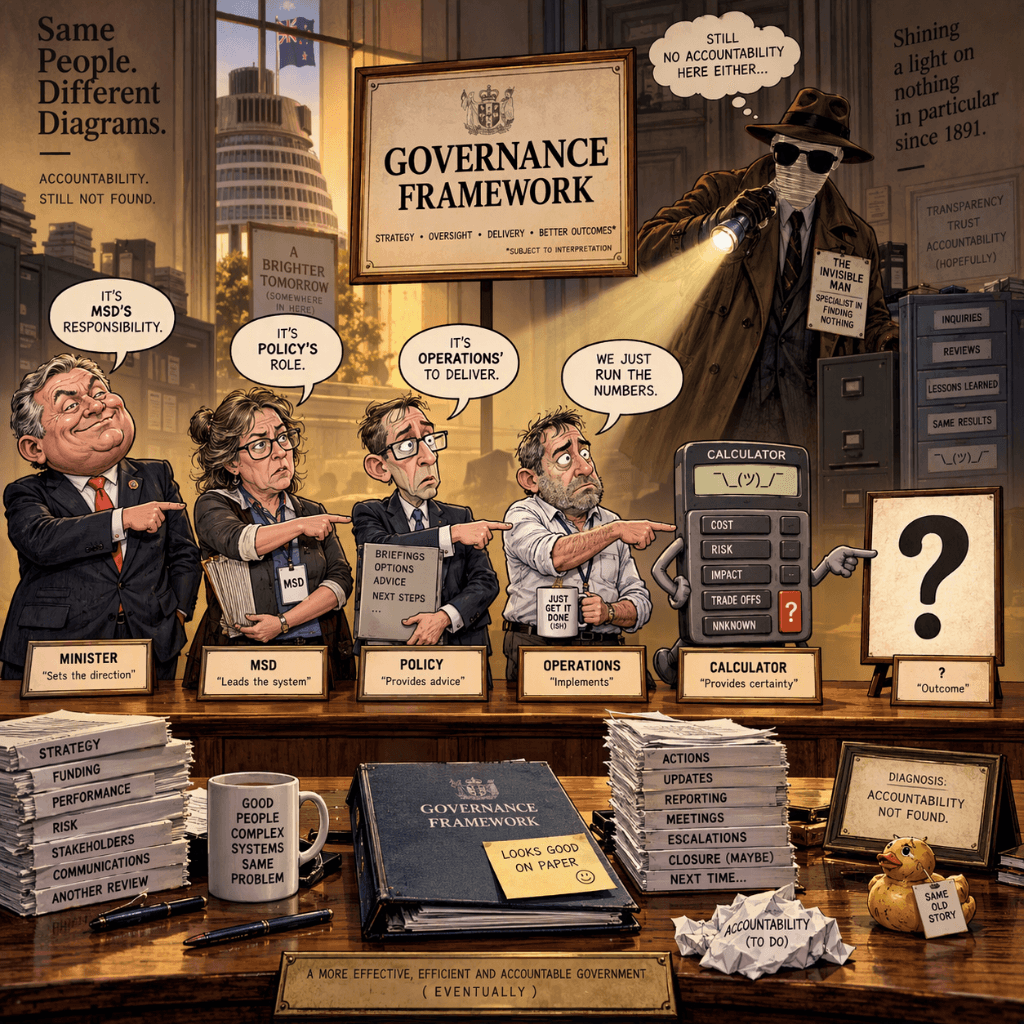
Treasury points to MSD.
MSD points to policy.
Policy points to operations.
Operations point to the calculator.
The calculator remains innocent throughout proceedings.
Because it only does what it is told.
Which brings us to MSD's most sophisticated modelling framework:
Garbage In → Garbage Out™
If the assumptions are wrong, the answer is wrong.
If the inputs are wrong, the answer is wrong.
If the classifications are wrong, the answer is wrong.
The calculator will still produce a result.
Beautifully.
Consistently.
Confidently.
Every single time.
And somehow nobody can tell you who owns the assumptions.
Kind Regards,
The Invisible Man
Acting General Manager, Operational Accountability Avoidance
Department of Garbage In, Garbage Out™
Bought to you by MOV ITx — we move it, prove it, then multiply it.
These are the voyages of Random Circuits, boldly entering the arena of ideas that disrupt, challenge, and transform.
Created with input from myself and Copilot assistance