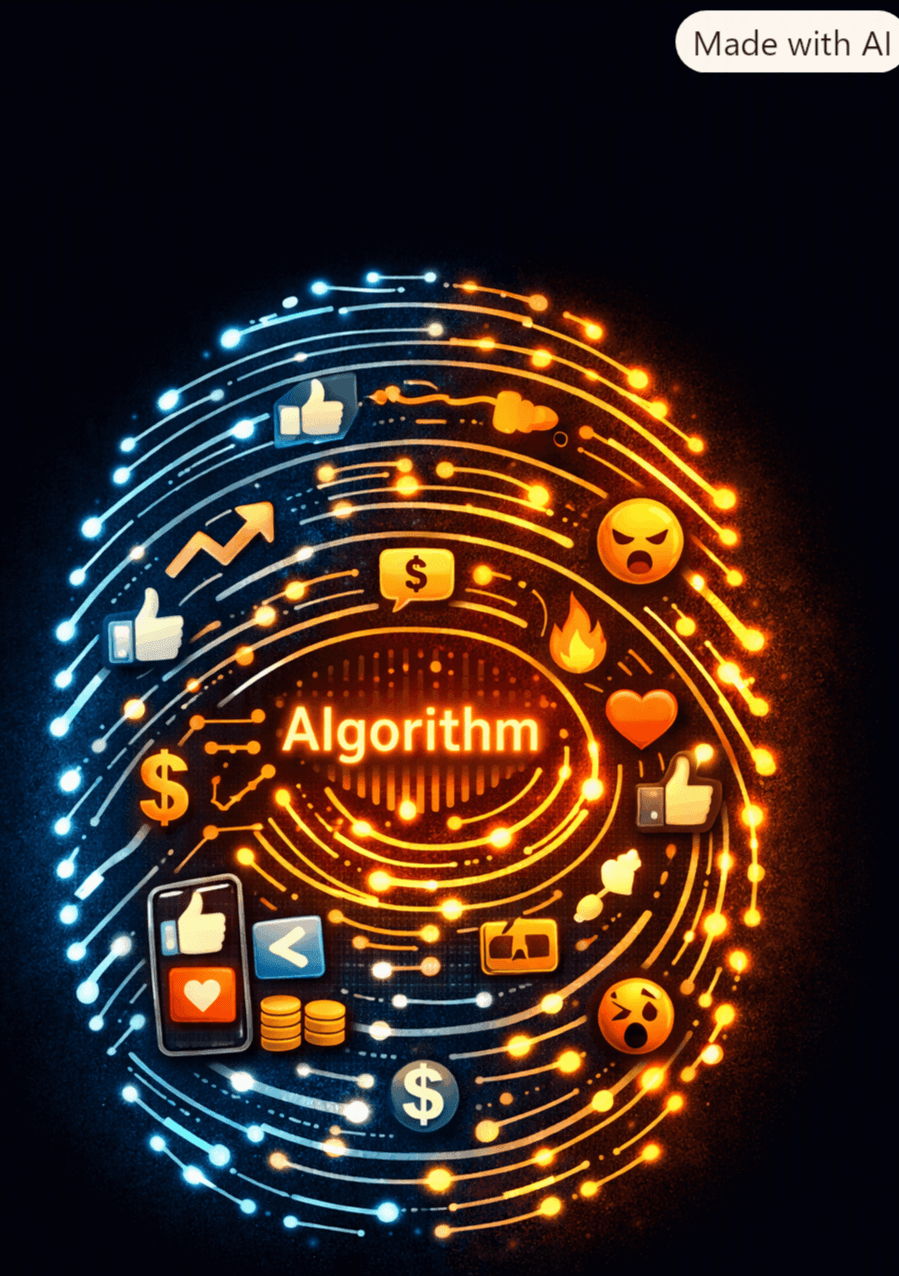
The social media algorithm has become its own ecosystem — feeding on conflict, growing on outrage, and never stopping long enough to ask whether it should.
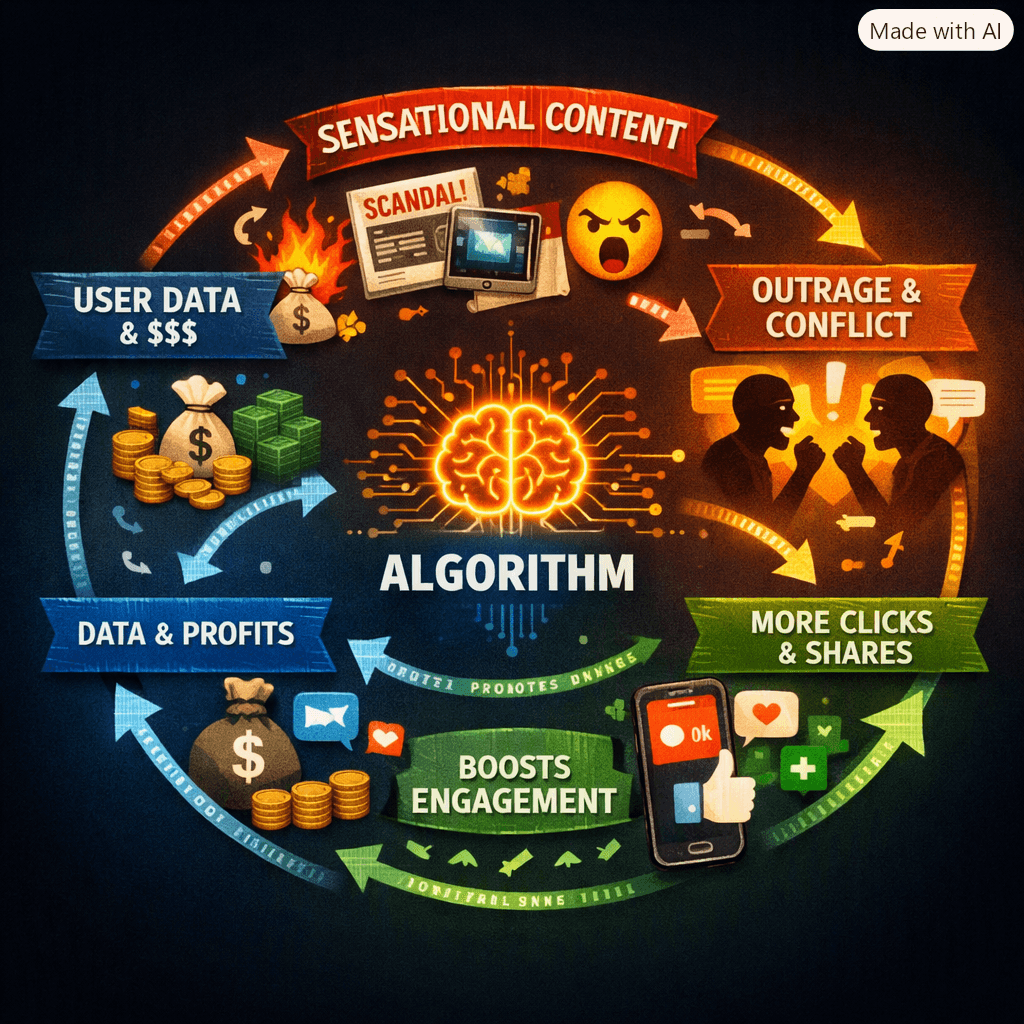
What began as a tool for connection has evolved into a machine that rewards the loudest emotions and recycles yesterday’s drama for profit. Every click, share, and reaction strengthens a loop that learns what provokes, not what informs. It amplifies gossip, accelerates conflict, and preserves harm long after it should have faded.
In this environment, reputations don’t recover, narratives don’t settle, and yesterday’s news never dies. The system keeps moving, keeps escalating, and keeps monetising — faster than society can respond and far faster than traditional remedies can catch up.
This blog explores how that loop formed, why it continues, and why the Movitx Digital Protection Act is designed to introduce ethics into a system that refuses to regulate itself.
When Yesterdays News Never Dies
Cheap gossip once had a natural end point.
Throwaway comments faded.
Yesterday’s news literally ended up wrapping fish and chips — forgotten, harmless, gone.
The digital amplifier changed that.
Now nothing fades.
Nothing disappears.
Nothing stays local or small or contained.
Yesterday’s news remains in the public domain forever — searchable, shareable, amplifiable, monetisable. Cheap gossip that once evaporated overnight can now follow someone for life. A throwaway comment that once meant nothing can now be weaponised globally.
Platforms make money out of conflict, so they continue amplifying conflict.
They have no reason to stop.
Because the harm isn’t in the gossip.
The harm is in the amplification.
The Nobody-to-Somebody Problem
A nobody becomes a somebody not because they have insight or value, but because their comment creates drama — and drama sells. That dynamic may have always existed, but it used to be contained. It didn’t escape into the world. It didn’t scale. It didn’t become permanent.
Now it does.
Social media takes what should be insignificant — a cousin’s remark, a neighbour’s rumour, a stranger’s speculation — and turns it into global conflict because conflict is profitable.
Cheap gossip is harmless until someone makes money from amplifying it.
Once conflict becomes a revenue stream, the system continues producing conflict.
Not voluntarily.
Not ethically.
Not responsibly.
Because the amplifier has no consequences.
The Society This Creates
A society where:
- conflict is rewarded
- gossip is monetised
- truth is optional
- reputations are disposable
- harm is scalable
- identity is fragile
- and “being known” no longer requires merit — only virality
This is not a connected society.
It is a volatile society, shaped by algorithms that amplify whatever pays.
And when taxpayer‑funded media participate in this cycle, the public ends up paying to destabilise itself.
Yesterday’s news used to die quietly.
Now it never dies at all.
Why Traditional Remedies Can’t Keep Up
It is not that class actions fail to fix systems.
It is that the system has already moved on by the time they catch it — and new problems have already been introduced while the conflict continues.
Digital harm is fast.
Class actions are slow.
Digital harm is continuous.
Class actions are retrospective.
Digital harm evolves.
Class actions chase ghosts.
By the time a case reaches court:
- the algorithm has changed
- the platform has pivoted
- the business model has shifted
- the harm has scaled
- the next distortion has already begun
The system outruns the remedy.
Where the Movitx Digital Protection Act Begins
The Movitx Digital Protection Act is designed for a world where:
- yesterday’s news never dies
- amplification is permanent
- conflict is profitable
- identity is vulnerable
- harm is global
- platforms move fast
- and governance must move faster
Its purpose is straightforward:
Introduce ethics into a system that refuses to regulate itself.
The Act reduces the incentive for platforms to amplify harmful content by imposing direct, immediate consequences on the systems that profit from it — consequences that operate at the speed of technology, not the speed of litigation.
Not censorship.
Not speech control.
Not policing opinions.
Amplification accountability.
The Movitx Digital Protection Act protects identities by targeting the amplifier, not the speaker.
It introduces consequences where none existed.
It forces platforms to carry the cost of the harm they create — instead of pushing that cost onto the public, the taxpayer, or the person whose reputation is destroyed for clicks.
This is the closing logic of Digital Bridge.
And the foundation of the Movitx Digital Protection Act.
Bridging the digital gap...
Brought to you by MOVITX — Introducing ethics to a system that refuses to regulate itself