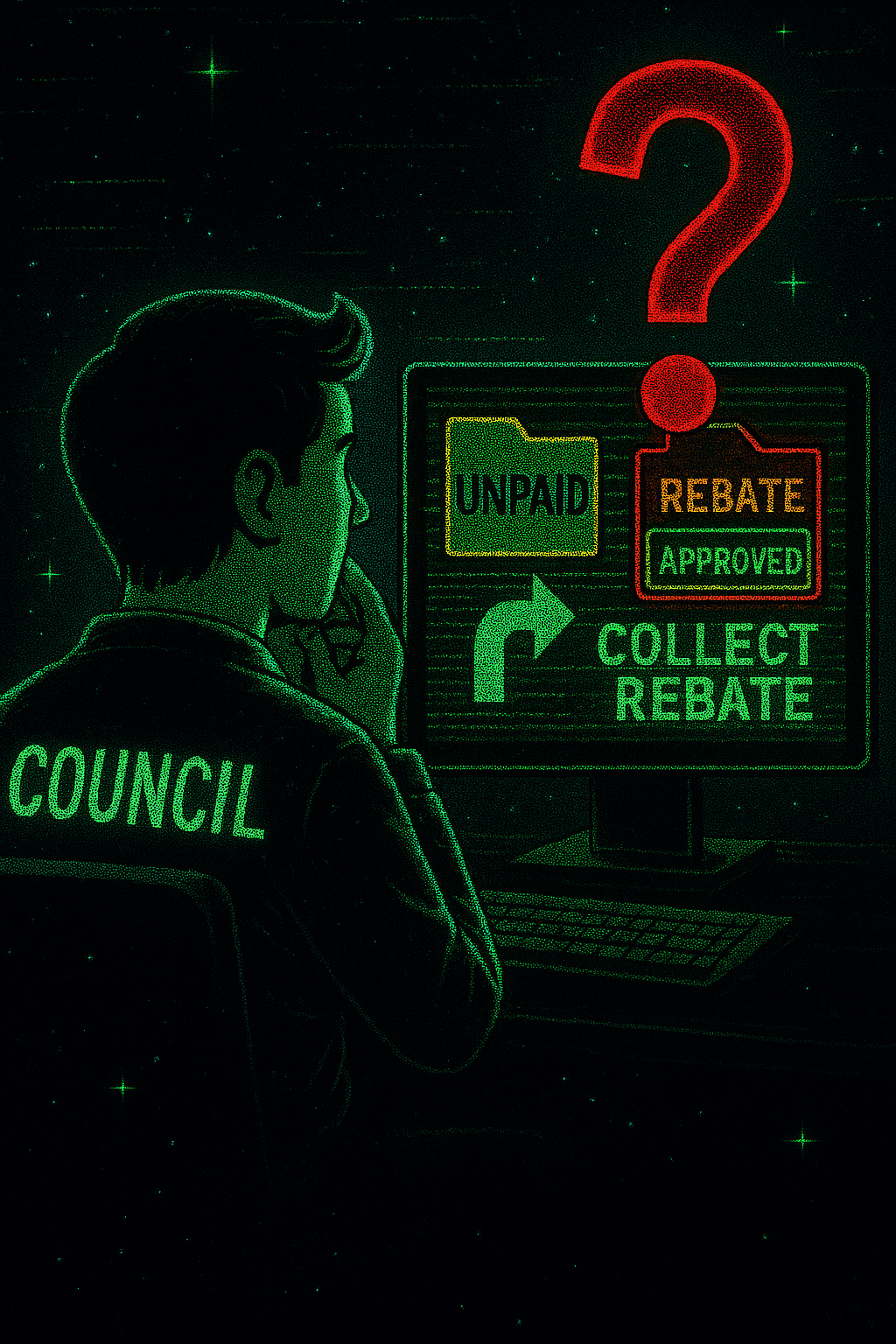
Welcome to Policy Paradox, the satirical board game where low-income homeowners roll the dice and navigate a rates rebate system designed to fail.Roll the dice: skip payment, collect rebate — welcome to the Policy Paradox.
This isn’t just a board game — it’s a civic glitch. When a policy is left unreviewed long enough, its original intent becomes redundant. What was meant to help struggling households morphs into a system that rewards liquidity tricks and punishes those who play by the rules.
In this game, the lesson is clear:
• Work the system by skipping payment, and you win.
• Follow the system by paying in full, and you lose.
The paradox isn’t about poor budgeting — it’s about poor policy design and lack of review. A rebate meant to ease hardship now teaches us how the system doesn’t work.

Game Setup
- Annual income: $40,000
- Council rates bill: $4,000 (10% of income)
- Law says: If your income is under the threshold, you’re entitled to a rebate.
The law doesn’t just look at income — it looks at how punishing your rates bill is. At $52,000 income, you’re on the edge, and only if your bill bites hard enough do you qualify. That’s the glitch: the system rewards those whose bills overwhelm their liquidity, while punishing those who manage to pay in full.
The Catch
- To get the rebate refund for last year’s rates, you must first pay this year’s rates in advance and in full.
- Translation: you need to pay two years’ worth of rates before seeing any refund.
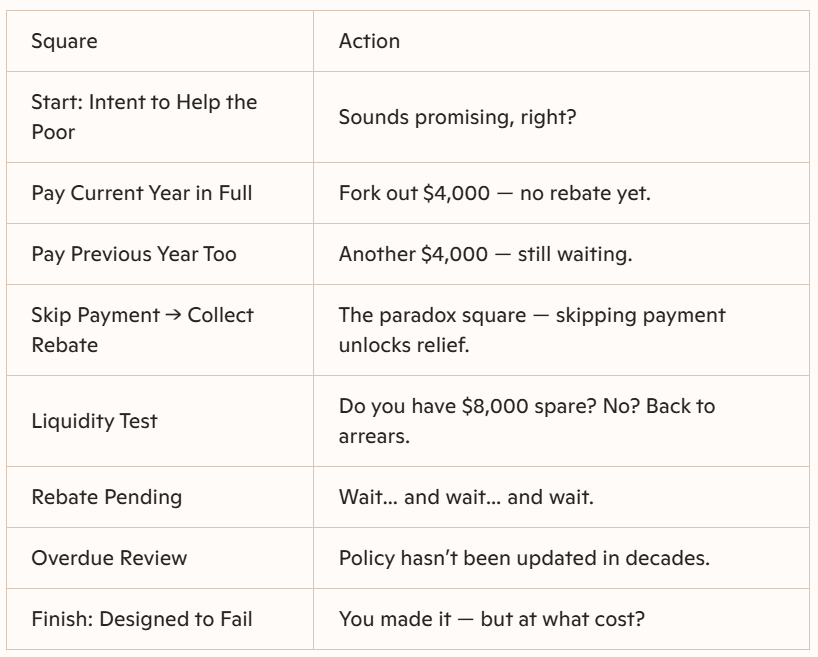
🧩 Game Board Squares
🌀 Gameplay Example
You roll a 4. Land on Pay Current Year in Full. You pay $4,000. Next turn, you roll a 3. Land on Pay Previous Year Too. You pay another $4,000. Still no rebate.
But your neighbor rolls a 6, lands on Skip Payment → Collect Rebate, and gets relief without front-loading. That’s the paradox.
🏁 Winning Strategy
- Don’t pay in full — hold back and apply strategically.
- Reframe arrears as liquidity logic.
- Document the flaw — this isn’t poor budgeting, it’s poor policy design.
🎯 Final Score
- Intent: Help low-income households.
- Effect: Reward liquidity, punish poverty.
- Motif: A rebate system where skipping payment is the winning move.
Ready to play? Just don’t expect fairness — this board was built to loop.
🃏 Rulebook Card: Thresholds Then vs. Now
1973: Intent Aligned
• It was unlikely they would ever near 10% of the income threshold to qualify.
• The rebate softened hardship without encouraging arrears.
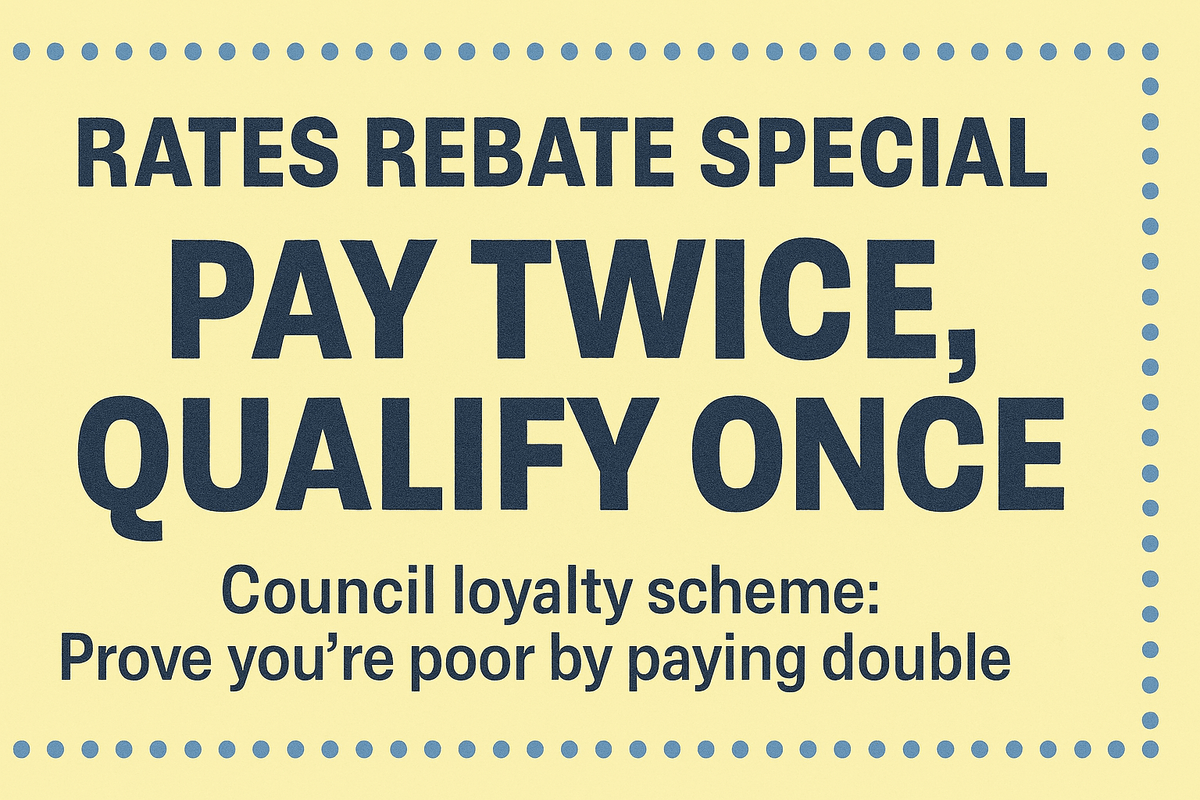
2025: Threshold Breached
• Rates bills now press closer to that 10% qualifying threshold.
• The intent has become redundant.
• Politicians have failed to recognise the glitch or make corrections.
• Households learn the paradoxical lesson: skip payment, collect rebate.
🏛️ Policy Legacy vs. Market Reality
The rates rebate scheme was designed in 1973, when household bills were modest and the qualifying thresholds made sense. Back then, it was unlikely your rates bill would ever near 10% of the income threshold set to qualify. The intent to ease hardship aligned with reality — the rebate softened costs without encouraging arrears.
Today, the picture is different. Rates bills now press closer to that 10% qualifying threshold, exposing the paradox: the system punishes those who pay in full and rewards those who don’t. Politicians have failed to recognise the glitch or make corrections, leaving households to learn the unintended lesson: skip payment, collect rebate.
Example Walkthrough
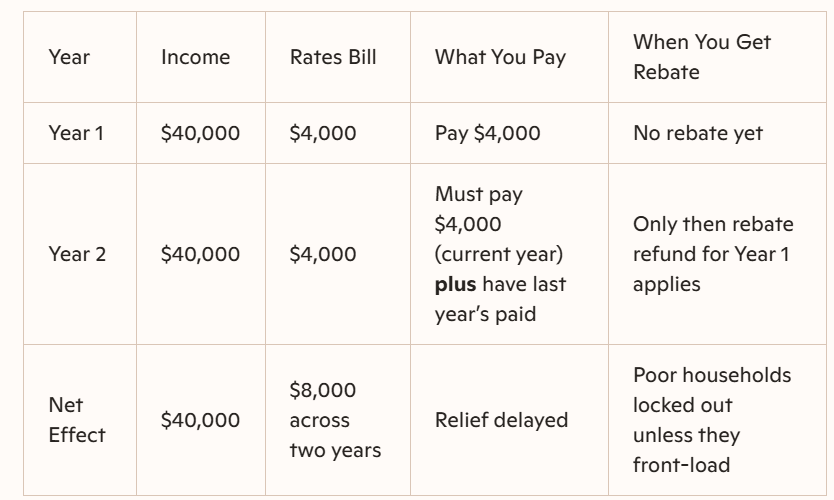
The Reality
- The rebate credit for this year’s rates: If you don’t pay this year’s rates in full, the credit is still applied against this year’s bill — not next year’s.
- If you’re already struggling to pay $4,000 upfront, you don’t have liquidity to cover $8,000 across two years before relief arrives. The system rewards arrears by removing the cash‑outlay barrier, while punishing compliance with double payment.
- Rational move: Don’t pay in full this year.
- Hold back, knowing the rebate will eventually offset arrears.
- The system unintentionally encourages arrears as a survival tactic.
🎯Playing the System
When rebates reward arrears, compliance stops being civic duty and starts being tactical delay. Citizens aren’t thriving under policy; they’re surviving it — navigating loopholes, stalling payments, and bending rules just to stay afloat.
This is what happens when policy loses touch with reality: the system becomes less about support and more about endurance. People aren’t playing for advantage; they’re playing to survive, forced into strategies that expose the absurdity of governance turned game.
Now imagine the opposite: a system that runs like a well‑oiled machine, not just smooth on the surface but designed to elevate people.Transparent, predictable, and anchored in lived reality, it would lift citizens instead of leaving them paddling furiously just to keep their head above water, fighting not to drown in the chaos.
That’s the reform worth fighting for — a system that doesn’t make survival the prize, but makes dignity the baseline.
By exposing these fractures, we reveal the paradox: endurance itself has become the prize. Real reform means policy that keeps pace with reality, so citizens no longer have to play the system to survive, but can trust it to support them instead.
These are the voyages of Random Circuits, boldly entering the arena of ideas that disrupt, challenge, and transform.