Ministers engineered the failure, but the Crown’s machinery endorsed it by allowing it to operate unchecked. Most businesses would be shut down if they kept pouring money into something that never delivers. Most people would lose their job. In government, it’s called a programme. In MSD, it’s called Tuesday. And the problem isn’t quirky anymore — it’s too big, too costly, and too visible to ignore.
And here’s the part no one ever seems to mention: if someone has ever wanted to do the work of a financial advisor without the qualifications, the training, the regulation, or the accountability… MSD has already perfected the model. The Crown regulates every financial adviser in the country because the law requires it.
MSD is exempt.
It just needs… a form.
And it excels at producing forms — not the kind that mean someone is good at sports, but the kind that bury people in paperwork, stall progress, and get quietly set aside just long enough to keep them compliant and quiet.
If anyone has ever wondered how a system can fail this consistently, cost this much, and still be considered functional, the answer begins here.
What follows isn’t the solution.
It’s the diagnosis — the map of the drift, the waste, the contradictions, and the quiet acceptance of failure that has gone on for far too long.
And that is where the story begins: with a system so normalised in its failure that the only responsible place to start is by naming it:
A System That Fails by Design
This isn’t rogue incompetence. It’s authorised incompetence — a system that misinterprets financial data, blocks access to money, and punishes people for circumstances they can’t control, all under the Crown’s seal of approval. Getting help shouldn’t feel like getting blood out of a stone, yet MSD delivers that experience with remarkable consistency.
And yes, not every beneficiary is perfect — but most don’t have the Bank of Mum and Dad to fall back on. They don’t have buffers, safety nets, or second chances. They come to MSD because they have nowhere else to go.
When the system fails, the customer is blamed.
When the customer fails, the system is defended.
MSD costs taxpayers billions every year, yet the crisis it is meant to address keeps getting worse. The problem doesn’t sit with beneficiaries — it sits with a vast organisation permitted to operate without demonstrating that it achieves its purpose. It has become a compliance machine, absorbing resources while producing outcomes that deepen hardship rather than reduce it.

A Culture Built on Mistrust
The culture mirrors the design. The moment you walk through the door, the system treats you as if you’re a bludger — someone seeking a handout, someone who must be doubted, monitored, and judged. But people don’t end up at MSD because they want to. Most arrive in circumstances they never expected, already carrying shame, fear, or overwhelm before they even ask for help.
The judgement is real, and it makes everything worse.
When things aren’t looking great, the most important thing isn’t a rule book.
It’s a human being who listens, who guides, who steadies the ground under you.
But MSD isn’t built for that.
It is built for compliance.
It is built on mistrust. It is built on the assumption that hardship is a personal failing rather than a circumstance. And that design choice shapes everything that follows.
When People Avoid the System, the System Has Failed
Here’s the part no one in government wants to acknowledge: people avoid MSD because of how they are treated. Some won’t even ask for help when they desperately need it. An organisation that people fear, avoid, or endure rather than trust is not a success. It is the opposite. It deepens crisis by driving people away from support and then blames them for falling.
Many people aren’t looking for a handout. They’re looking for a hand up — a chance to stabilise, rebuild, and move forward. But MSD isn’t built for that. It is built to police, not to support.

People Don’t Disengage Because They’re Lazy
People don’t disengage because they’re lazy.
They disengage because every step of the process tells them they’re not trusted.
Because the requirements don’t reflect their lives.
Because the support is conditional.
Because the effort demanded is greater than the help provided.
Disengagement isn’t a personal flaw.
It’s the predictable outcome of a system designed this way.
See the Absurdity
If it weren’t affecting people’s income, time, and stability, the whole thing would read like satire:
Here’s a carrot.
Also, here’s a stick.
Also, here’s a form.
Also, here’s a course.
Also, here’s a deadline.
Also, here’s no actual help.
It’s Kafka with a customer service number — a bureaucracy that performing the appearance of support rather than delivering it.
A System That Treats Everyone Like They’re the Same
MSD operates on the assumption that everyone fits the same mould — and if you don’t, the system treats you as if you do anyway. It’s the policy equivalent of declaring that everyone in the country wears a size 8 shoe, then calling itself a success when people limp. The model isn’t built for variation, so variation is treated as failure.
It’s the same logic Henry Ford used when he said customers could have any colour they wanted, as long as it was black. MSD has built an operating model with one colour, one size, one pathway — and then acts surprised when people don’t fit neatly into it. The moment someone introduces “colour” — complexity, nuance, real life — the system can’t cope. And instead of adapting, it blames the person for not fitting the template.
This isn’t a people problem. It’s a system that mistakes uniformity for fairness — and punishes anyone who falls outside its template.
The Wastage of Treating Everyone the Same
The system doesn’t just assume everyone fits the same mould — it funds that assumption. Want to start a business? MSD will funnel you into courses you already have degree‑level papers in, delivered by providers paid to tick compliance boxes rather than add value. There’s no choice in the matter. If you don’t attend, you don’t get paid. And somehow this is labelled “support.”
It’s the policy equivalent of insisting everyone wears a size 8 shoe, then spending taxpayer money manufacturing size 8 shoes for people who very clearly aren’t size 8. The waste isn’t subtle — it’s structural. Public money is poured into programmes that deliver the least value to the people who need the most.
It’s the Henry Ford model all over again: you can have any support you want, as long as it’s the one already on the shelf. The moment someone brings “colour” — capability, experience, or actual expertise — the system can’t recognise it. It forces everyone back into the black‑only model and calls that equality.
This isn’t efficiency. It’s waste disguised as fairness.
How Are These Programmes Even Measuring Success?
The system treats everyone the same, and then measures its success by how many people it can push through that sameness. Want to start a business? You’ll be sent to courses you’ve already surpassed academically, delivered by providers whose performance is measured in attendance, not outcomes. If you don’t go, you don’t get paid. And somehow this is counted as a successful intervention.
How are these programmes assessed on success?
By driving overqualified people through irrelevant content, forcing them to sit in rooms where they learn nothing, and then claiming victory when those same people eventually leave the benefit — not because the programme helped them, but because they were already capable. The system takes credit for outcomes it didn’t create.
What value does this deliver to the person?
None.
It delivers value to the spreadsheet.
It delivers value to the provider.
It delivers value to the compliance machine.
But to the person?
Only lost time, lost income, and lost dignity.
The system funnels everyone through the same sausage factory and calls that fairness.
It’s not fairness. It’s waste disguised as equality.
The Sausage‑Factory Approach to Job Support
The same wastage shows up in job‑search support. Ask for help finding a job, and the system will send you to a course where the facilitators look at the same job listings you already check every day. They’ll call you weekly to “see how things are going,” as if monitoring were the same as support. And when they run out of ideas, they’ll suggest removing your degree from your CV so you can apply for jobs you’re wildly overqualified for — and then call it a success when you eventually get one.
This isn’t support.
It’s throughput.
It’s the sausage‑factory logic again: push everyone through the same narrow tube and declare the output “effective.”
The system isn’t built to recognise capability, experience, or ambition. It’s built to funnel people into the quickest, cheapest, most generic pathway and then take credit for outcomes it didn’t create. The question no one inside MSD ever asks is the only one that matters: what value does this deliver to the person?
And the answer is always the same:
lost time, lost income, lost dignity.
It’s not support.
It’s a production line pretending to be a service.

Structure Isn’t the Problem — Uniformity Is
The issue isn’t that the system has structure.
It’s that the structure assumes everyone is the same.
MSD treats uniformity as fairness — one pathway, one process, one definition of “support.” It forces everyone through the same narrow channel and then calls the result consistent. The consequences are predictable: wasted money, wasted time, and wasted potential.
It’s the size‑8‑shoe logic again.
Not everyone fits, but the system keeps manufacturing the same size and insists the problem lies with the people who limp.
A system built on sameness can only ever deliver the lowest common denominator, because it refuses to recognise that not everyone wears the same shoe size.
Initiatives That Are Never Reviewed
MSD doesn’t just create programmes; it preserves them in amber. Initiatives are launched, funded, and then left untouched for years. There is no meaningful review, no evaluation of outcomes, no assessment of value for money. The system simply assumes that if a programme exists, it must be working. And because no one checks, nothing improves.
Successive governments have repeated the same pattern. The social development portfolio is treated like a game of pass‑the‑parcel — each minister inherits a box of outdated programmes, wraps another layer of policy paper around it, and hands it on without ever opening it. No one wants to be the one who admits the contents are broken. No one wants to be responsible for confronting a system this large.
So the parcel keeps moving, untouched, unexamined, and increasingly irrelevant.
Don’t Look Under the Covers
The entire portfolio operates on an unspoken rule: don’t look too closely. Don’t lift the covers. Don’t examine whether the programmes work. Don’t ask whether the money is being spent wisely. Because if anyone actually opened the box, they might not like what they found — outdated initiatives, unreviewed programmes, and a compliance machine that costs millions while delivering almost no measurable value.
This isn’t oversight.
It’s avoidance dressed up as continuity.

Another Initiative, But Don’t Check If It Works
MSD has a habit of launching initiatives the way some people buy gym memberships — with enthusiasm on day one and absolutely no follow‑through. A new programme is created, funded, and rolled out nationwide, and then… nothing. No review. No evaluation. No measurement of whether it actually helps anyone. It simply becomes another permanent fixture in the system, another box to tick, another compliance requirement to enforce.
This isn’t innovation.
It’s accumulation without accountability.
A Monster With Too Many Heads
Somewhere along the way, MSD stopped being a ministry and became a monster — not through deliberate design, but through decades of accumulated responsibilities. Whenever a new payment stream or administrative task emerged, it was added to MSD by default. Over time, the organisation absorbed functions that had little in common beyond the fact that they involved people and money.
It is responsible for:
• income support
• hardship grants
• housing assistance
• employment services
• disability support
• youth services
• family services
• community funding
• fraud investigation
• compliance and enforcement
• emergency response
• long‑term social policy
• student loans
• and, inexplicably, new business start‑up support
These functions don’t form a coherent portfolio.
They don’t share natural rhythms, expertise, or operating logic.
They were never designed to sit together.
Fraud investigation sits alongside social support.
Student loans sit alongside emergency housing.
Business start‑up support sits alongside disability services.
These aren’t just unusual combinations.
They are structural mismatches created by decades of political convenience — and the people inside the system enforce those mismatches every day.
This isn’t just a portfolio problem.
It’s a failure of responsibility.
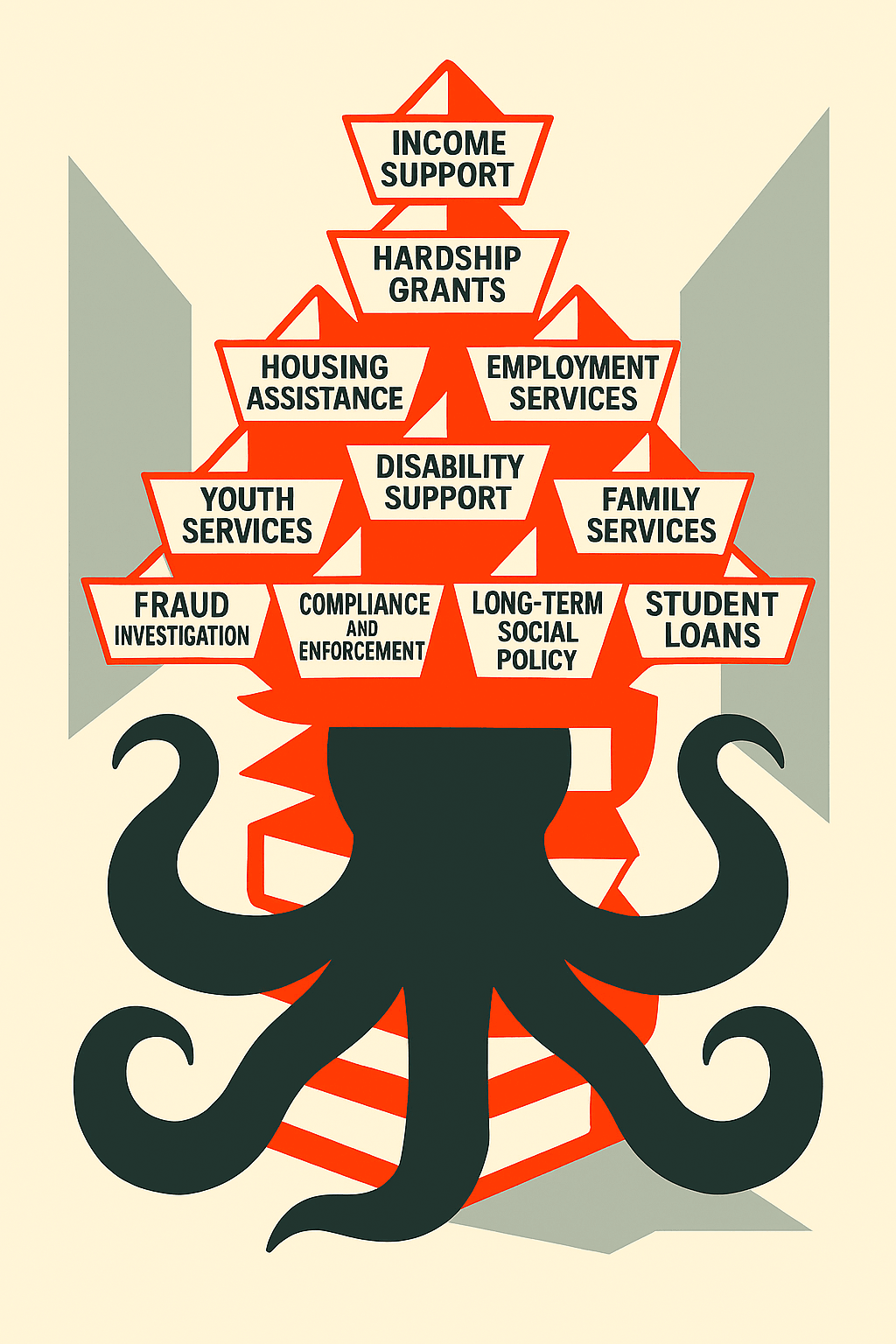
The Failure of Running all of these Services the same way
None of the functions inside MSD are impossible on their own. Income support, housing assistance, disability services, employment support, hardship grants, student loans — each of these can be run well when they sit inside systems built for their purpose.
The problem is that MSD runs all of them as if they are the same kind of work.
Functions that require different skills, different mindsets, and different operating rhythms are forced through the same machinery. Complex needs are processed with the same tools used for simple ones. Specialist tasks are handled with generalist processes. Everything is flattened into one model, one pathway, one definition of “support.”
The result isn’t coherence.
It’s distortion.
People with very different realities are pushed through the same system, and the system calls that consistency. But consistency isn’t the same as effectiveness — and it certainly isn’t the same as understanding.
This is why MSD has become a monster.
Not because it is large, but because it treats structural diversity as administrative inconvenience.
And If There Were Awards for Failure…
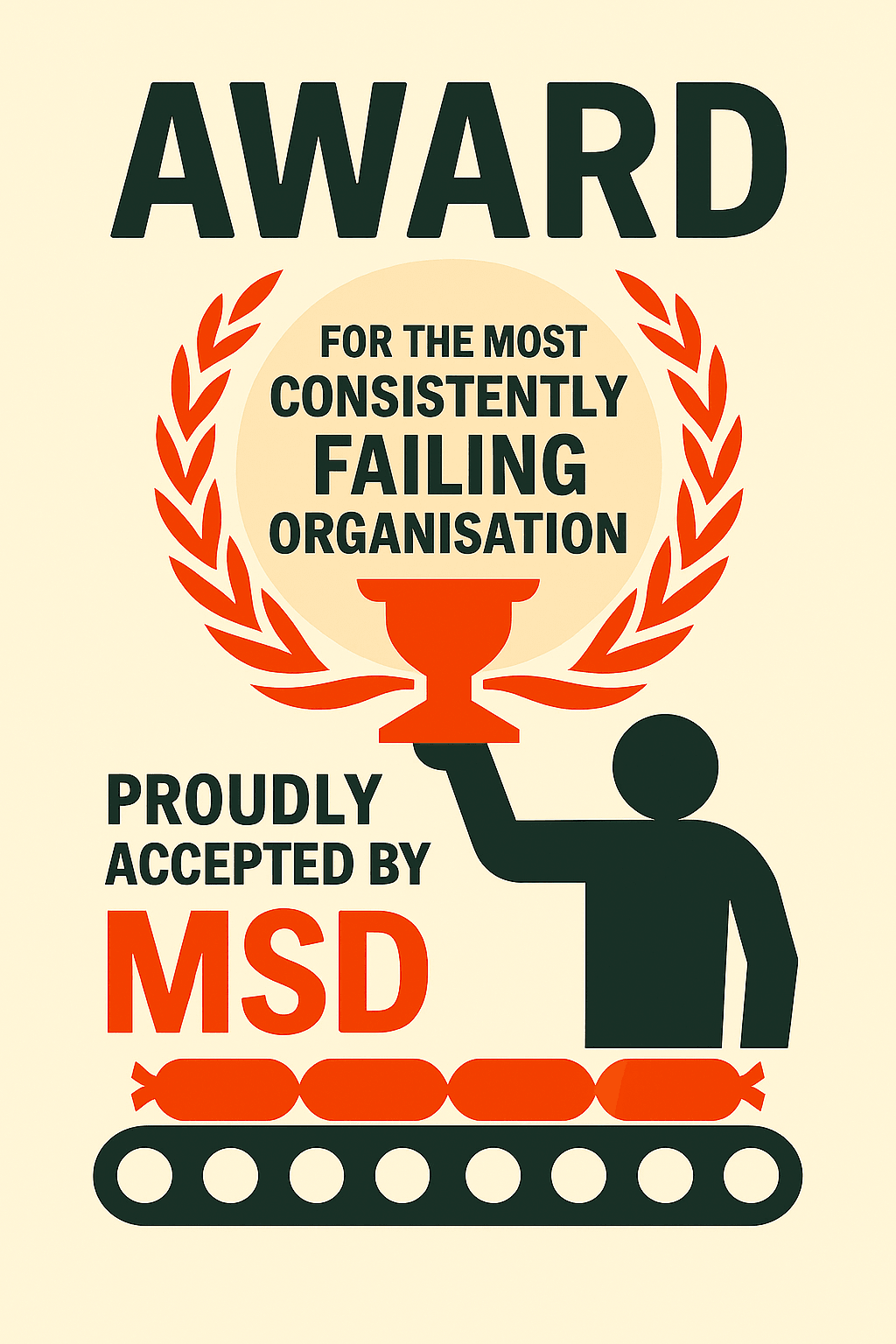
If there were an award for the most consistently failing organisation in New Zealand, MSD would win it every year — not for lack of funding, but for lack of purpose, direction, and accountability. It is a system that has mastered the art of doing the same thing repeatedly while expecting a different result, and somehow convincing successive governments to applaud.
The tragedy isn’t just the failure.
It’s the acceptance of the failure.
The quiet, generational shrug that says, “This is just how it is.”
Designed from the Outside In
After all the layers of misalignment, waste, and structural incoherence, one pattern becomes impossible to ignore: MSD designs everything from the outside in.
It starts with the programme, not the person.
The product, not the need.
The rule, not the outcome.
This is how you end up with support that looks helpful on paper but fails in practice — assistance that matches the system’s assumptions rather than the person’s reality. Barriers that matter are overlooked, while boxes that don’t matter are ticked. The result is a model that performs support rather than delivering it.
A system built this way can only ever replicate its own logic.
It cannot see the person standing in front of it.
And it cannot change, because it cannot recognise what needs to change.
Until that shift happens, MSD will continue to win the same award every year:
The most consistently failing organisation in New Zealand.
Why Project Juggernaut Begins Here
MSD isn’t an alien monster.
It’s something we built — layer by layer, rule by rule, workaround by workaround — until it grew into something no one can steer.
And because it was created, it can be changed.
It can be reshaped.
It can be tamed.
Project Juggernaut begins here because naming the problem is the first act of reform.
This document isn’t the solution — it’s the diagnosis.
It’s the map of the harm, the pattern, the absurdity, and the structural drift that has turned a public service into a machine that no longer serves.
But taming the monster isn’t charity.
It’s structural reform.
And structural reform only happens when the work is recognised, resourced, and commissioned — not when it’s pushed onto individuals to solve in the margins of their day jobs.
This is the argument for change — not the unpaid labour of designing the solution.
Bought to you by MOV ITx — we move it, prove it, then multiply it.
These are the voyages of Random Circuits, boldly entering the arena of ideas that disrupt, challenge, and transform.