
The social support system in New Zealand runs on financial rules no one can see, no one can explain, and no one will claim responsibility for — despite controlling access to $32 billion in public spending. This piece looks at how an invisible, unregulated rulebook shapes real‑world outcomes, why accountability keeps disappearing into a “not‑me” loop, and what happens when a system built on assumptions meets people whose lives don’t fit the script.
When the rules that decide people’s lives have no author
In most parts of government, rules have owners. Tax rules belong to IRD.
Employment rules belong to MBIE.
Monetary policy belongs to the Reserve Bank.
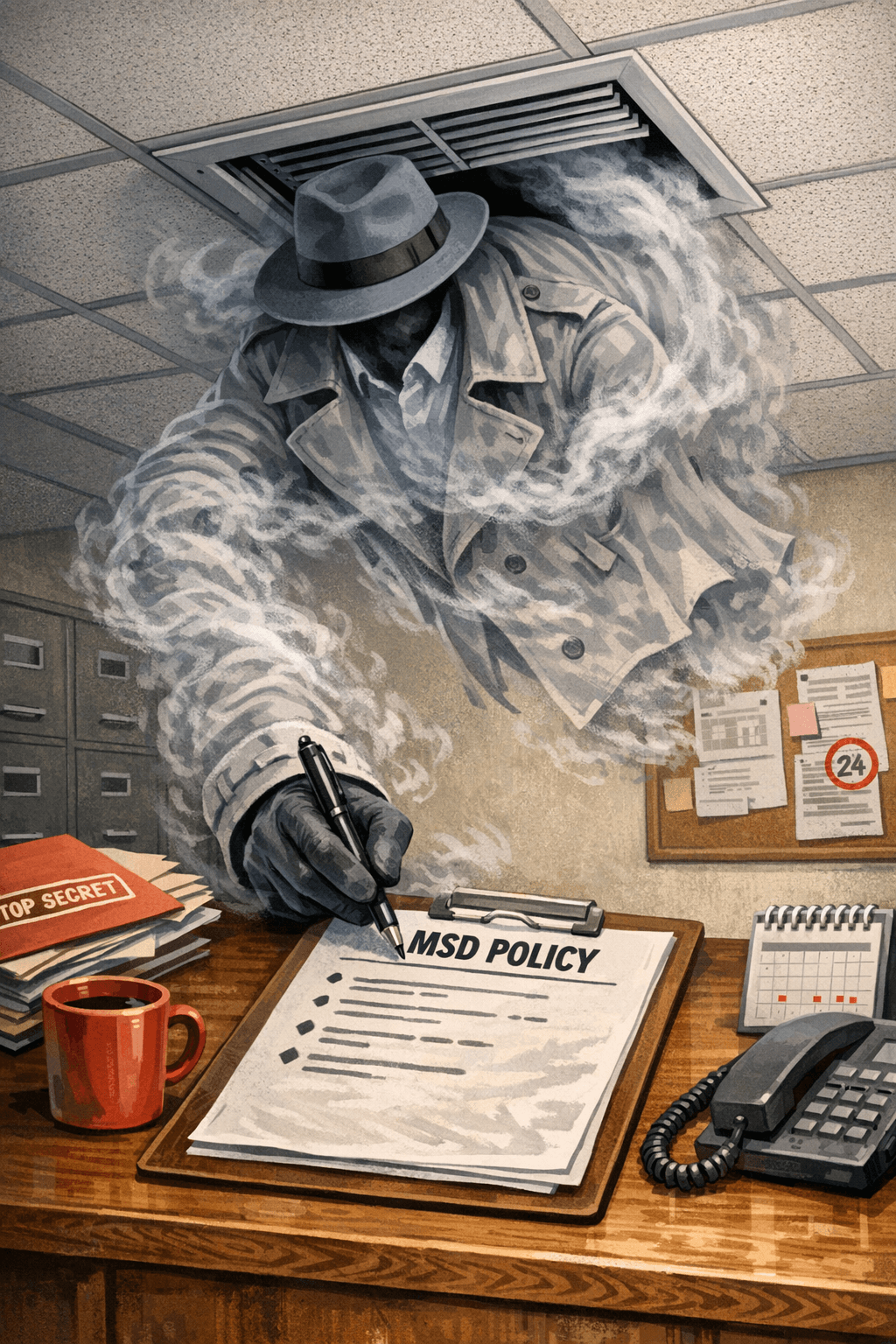
But the financial rules used by MSD — the ones that determine whether someone receives support, gets declined, or is pushed into crisis — appear to have been written by someone no one can identify.
An invisible man, perhaps.
No legislation.
No alignment with IRD.
No audit trail.
No published standards.
No accountable owner.
Just “operational settings” that somehow decide whether a person eats, pays rent, or ends up sleeping in their car.
Even non‑accountants can see the beans aren’t adding up.

The $32B irony: standards for everything except the agency that needs them most
New Zealand regulates almost everything:
- cafés
- hairdressers
- playground equipment
- food trucks
- school tuck shops
Yet the agency responsible for hardship support, homelessness prevention, and emergency assistance is effectively told:
“Here’s $32 billion. Go help people. Use whatever financial definitions the Invisible Man left lying around.”
If a small business received $32B with no standards, no oversight, and no audit requirements, accountants across the country would collapse in a heap.
But for MSD, this arrangement is treated as normal.
The question no one wants to answer: who is responsible?
When the question of ownership is raised, the system becomes noticeably quiet.
Who wrote the definitions? Shrug.
Who approved them? Different shrug.
Who audits them? Silence.
Who is responsible for the financial rules that determine access to essential support?Apparently no one.
Not the Minister — the office has confirmed the rules aren’t in legislation.Not Treasury — they don’t review them.
Not IRD — the definitions don’t match theirs.
Not any regulator — because there isn’t one.
A $32B agency with no financial standards and no accountable owner of the rules.
Mind blown.

The consequences aren’t theoretical — they’re visible on the streets
This isn’t a technical quirk or a bureaucratic footnote.The fallout is real, immediate, and painfully visible:
- families living in cars
- children couch‑surfing
- people skipping meals
- individuals sanctioned into homelessness
- applicants declined based on definitions that don’t exist in law
Bad definitions lead to bad decisions.Bad decisions lead to bad outcomes.
And those outcomes are walking around in plain sight.
“Does it affect me?”
Yes — because you’re paying for it, and you’re living with the fallout
There’s a common assumption that if someone isn’t on a benefit, this issue doesn’t touch them. But it does — directly.
Every taxpayer is funding a $32B system built on undefined rules, unreviewed decisions, and a governance vacuum no private organisation would survive. And when those rules fail, the consequences don’t stay neatly contained inside MSD’s offices.
They spill onto the streets.Into emergency housing budgets.
Into policing.
Into health services.
Into schools.
Into communities.
A system with no standards doesn’t just fail the people who need help. It fails the people who fund it. And it fails the country that has to absorb the fallout.
“Why should I care?”
Because the system assumes everyone starts from the same place — surprise, they don’t
Another quiet assumption sits underneath the whole conversation: that the people who need MSD have the same starting point, the same resources, the same stability, and the same capacity to navigate complexity as everyone else.
They don’t.
Some people enter the system already carrying housing instability, health issues, trauma, debt, caregiving responsibilities, or years of compounding disadvantage. Others are dealing with sudden crises — job loss, relationship breakdowns, illness, or unsafe living situations.
Yet the system treats everyone as if they’re beginning from the same baseline.As if they have the same bandwidth.
As if they have the same resilience reserves.
As if they have the same margin for error.
As if they have the same bank of Mum & Dad.
They don’t. And when a system built on invisible rules meets people with very visible needs, the gap becomes a trap.
“Why aren’t they in jobs?”
Because survival is a full‑time occupation
Another familiar refrain is, “Why aren’t these people working?” The answer is far less mysterious than the rules themselves.
People who are constantly cycling through crisis — housing insecurity, food insecurity, sanctions, declined applications, emergency relocations, debt spirals, and repeated reassessments — are not in a position to thrive. They are too busy trying to survive.
A system built on undefined rules doesn’t create stability. It creates churn.
And churn keeps people trapped in the very circumstances critics claim they should simply “work their way out of.”
Thriving requires a foundation. This system removes the floor, then asks why people can’t stand.
The Silence is Deafening
The system’s reluctance to identify an owner for the rules is telling. When the definitions that decide people’s lives have no author, no reviewer, and no accountability, the absence of answers becomes the answer.
Which leaves one final question hanging in the air:
If the Invisible Man wrote the rules…why is nobody asking who handed him the pen.
Mind blown.
Bought to you by MOV ITx — we move it, prove it, then multiply it.
These are the voyages of Random Circuits, boldly entering the arena of ideas that disrupt, challenge, and transform.