Introducing more than 300,000 children and the sole parents raising them — a voting block big enough to swing an election — are the forgotten ones of policy writing. They’re never centred, never counted properly, never even seen. How do we know? Because the moment MOVITX asked the system, it just scratched its head. No data. No insight. No curiosity. A machine running blind. And when a system has no data, it has no care — because invisibility is the easiest way to avoid accountability.
Aotearoa NZ loves to say it “supports families,” but that promise quietly excludes the ones carrying the heaviest load. .This drop exposes exactly that: a structure built on bias, maintained through neglect, and defended by people who’ve never had to survive it.
The System Bias That Could Swing an Election
A structural breakdown of the machinery that manufactures child poverty — and the mindset that allowed it to survive for decades.
Every election year, politicians scramble to understand “the mood of the nation.”
They commission polling.
They run focus groups.
They obsess over swing voters, undecideds, and the mythical “middle New Zealand.”
But there’s one group they never talk about.
Not because it’s small.
Not because it’s hard to find.
But because the system has quietly decided they don’t matter.
Let me introduce you to the estimated 340,000 children growing up in sole‑parent families in Aotearoa — a population the size of Christchurch — who are statistically invisible unless they appear in a “problem” dataset.
And if you think that’s just a data issue, think again.
This is the kind of system bias that could swing an election.

🗂️ The System’s Favourite Trick:
Track the Problems, Ignore the People
For sole‑parent families, the system tracks:
• truancy
• benefit receipt
• CYF notifications
• justice involvement
• emergency housing use
• deprivation
It’s a rich buffet of deficit.
But when it comes to anything that might indicate whether the system is actually working for these families — long‑term mobility, home ownership, income growth, educational achievement, intergenerational outcomes — the data suddenly evaporates.
It’s not a glitch.
It’s a worldview.
📊 The Group That’s Apparently Too Large to Notice
There are 213,534 sole‑parent families in Aotearoa.
Multiply that by the average 1.6 dependent children per family and you get:
≈ 340,000 children.
One in five kids.
A whole city’s worth of future adults.
And yet the system behaves as if they’re a statistical rounding error.
We pour millions into tracking long‑term outcomes for almost every other group — but for these children?
Nothing.
Not a single long‑term outcome measure.
Apparently, the system only remembers this group exists when it needs someone to blame, not when it needs someone to invest in.
🧠 How to Uncover Systemic Bias:
Ask a Question the System Can’t Answer
Just ask the system something basic:
• “Do these children thrive?”
• “Do they break cycles?”
• “Do they become homeowners?”
• “Do they stay in the country?”
• “Do they become voters?”
Watch the system blink.
“I see,” said the blind man — but he never saw at all.
Bias hides not in what the system measures,
but in what it refuses to measure.
🥛 Is Your Glass Half Full, or Did the System Just Forget to Measure It?
People love to ask whether your glass is half full or half empty.
But for sole‑parent families, the system never measured the glass in the first place.
It only recorded the cracks.
When a system only measures the negative, the negative becomes the expectation.
And once the expectation is set, the data becomes prophecy.
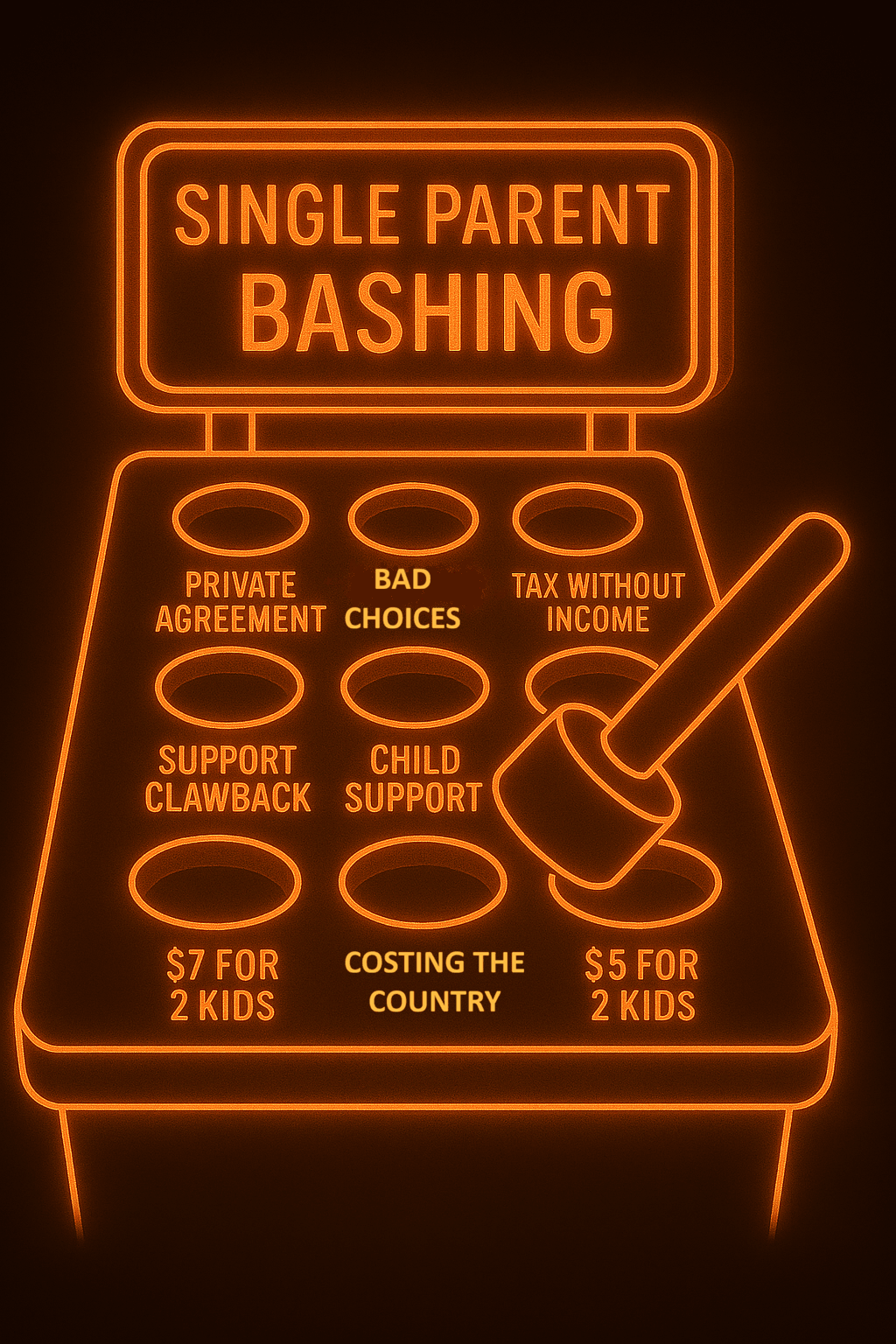
📺 Brace Yourself — It’s Single‑Parent Bashing Season Again
Because it’s an election year, we all know what’s coming:
Single Parent Bashing™ — Season 4,000.
The same lines appear like clockwork:
• “It’s the parents’ fault.”
• “They should’ve made better choices.”
• “They’re costing the country.”
All delivered by people who have never raised a child alone, never lived on one income, never paid legal fees to keep a child safe, and never once asked whether the system actually works for these families.
Judging is free.
Supporting costs money.
Guess which one the system prefers.
💸 Add Legal Bills, School Drop‑Offs, and a Single Income
Then Act Shocked They’re Poor
Nothing says “we value families” like:
• expecting a sole parent to drop kids at school and arrive at work on time
• forcing them to pay legal fees just to protect their child
• stretching one income across rent, food, uniforms, petrol, and court costs
• and then acting bewildered when they’re not thriving
If the system doesn’t measure the difference,
it can pretend the difference doesn’t exist.
💥 “Shouldn’t Have Kids If You Can’t Afford Them”
The System’s Favourite Moral Shortcut
This line always arrives on schedule.
As if people plan pregnancies around future court dates.
As if abuse never happens.
As if leaving an unsafe home is a “financial choice.”
Many sole‑parent families didn’t choose poverty.
They chose safety.
And the system responds by refusing to measure whether its support actually works.
No data.
No responsibility.
No accountability.
🍽️ The System That Steals From Children
Then Wonders Why They’re Poor
Here’s the real recipe for child poverty:
1. Take money intended for children.
2. Divert it to offset benefit costs.
3. Give the child a token amount.
4. Tax that token amount like it’s income.
5. Blame the parent.
And if you’re working?
You get the deluxe version:
• a trivial payment
• taxed
• means‑tested
• treated as if it’s some kind of luxury bonus
Meanwhile, parents who live together can support their children privately without government interference.
But if you need help?
Kiss goodbye to any private arrangement you made.
The system will take that money and use it for itself.

⚖️ And the Best Part? They Made It Legal.
They didn’t just do this.
They legislated it.
They wrote into law:
• that they can divert child‑support money
• that they can keep it
• that they can tax you on money they never gave you
• that they only pass on payments if they collect them
• that private arrangements don’t count unless they say so
It’s like a courier company charging you for a parcel they never picked up.
A legally sanctioned mechanism where:
• the system only pays if it collects
• it taxes you as if it paid
• it diverts money intended for children
• and then wonders why child poverty exists
A masterpiece of circular logic.
🏚️ Oh, You Have a Property? The System Has Entered the Chat.
And if your private arrangement involves property?
The system can put a caveat on it — without even notifying you.
No warning.
No conversation.
No courtesy call.
Just a quiet legal footnote slapped onto your title like a parking ticket you didn’t know you got.
Because nothing says “supporting children” like interfering in private agreements that were actually working.
💸 A Challenge for the Well‑Paid Decision‑Makers
There’s an entire political class earning six‑figure salaries, surrounded by advisors, portfolios, and strategy documents about child poverty.
So here’s a simple, practical challenge:
Take the average income of a single‑parent household.
Tax it first — just like the system does.
Then add seven dollars a week.
Don’t forget to tax the seven dollars too.
Now pay market rent.
And support two children.
No extras.
No shortcuts.
No hidden subsidies.
No “just ask the other parent.”
No “budget better.”
No “work more hours.”
Just the exact conditions the system imposes on the families it claims to support.
Can they make that work.
Because if the people designing the rules can’t survive under the rules they expect families to live by,
then the problem isn’t the families.
It’s the rules.
🧩 What Was at the Centre of the Design Thinking?
And when you look at how this system operates — the diversions, the taxation of money never received, the override of private agreements, the caveats placed on property without notice, the lack of review, the absence of accountability — another question becomes impossible to ignore:
What was at the centre of the design thinking?
Because it certainly wasn’t children.
A child‑centred system would measure what matters.
It would protect what matters.
It would invest in what matters.
Instead, the design logic looks like it was built around:
• administrative convenience
• cost containment
• assumptions about families
• and a worldview that never included the lived reality of sole‑parent households
So the real question becomes:
If children weren’t at the centre of the design,
what was.
🧩 The Gap Between Enforcement and Understanding
And here’s the part that sits uneasily with me:
The people enforcing the rules don’t actually understand the problem the rules create.
They see fragments — a form, a payment, a policy line, a checkbox.
They see tasks, not consequences.
They see compliance, not impact.
They don’t see:
• the rent that’s due
• the food that runs out
• the legal fees stacking up
• the exhaustion of doing everything alone
• the reality of being taxed on money that never arrived
• the private agreements overridden
• the property caveated without warning
They’re enforcing a system they’ve never had to survive.
And because they don’t understand the problem,
they can’t recognise the harm.
So “that’s the rules” becomes a shield —
a way to avoid seeing what the rules actually do.
A system can survive for decades when the people enforcing it don’t understand the damage it causes.
That’s how this one lasted so long.
🧩 The Generational Mindset No One Wants to Admit
And there’s a deeper layer to all of this — one that stretches back generations.
A mindset that says:
Anyone who needs a benefit must be a bludger.
Anyone who needs support must have failed.
Anyone who asks for help can’t be trusted.
It’s a worldview baked so deeply into the system that people don’t even recognise it as a belief anymore.
It’s treated as fact.
As common sense.
As “just how things are.”
And because that mindset goes unquestioned:
• families who need support are treated with suspicion
• frontline staff enforce rules built on distrust
• private agreements are overridden
• money intended for children is diverted
• parents are taxed on support they never received
• and the system is designed around preventing “misuse,” not enabling success
This isn’t just policy.
It’s culture.
A culture that assumes the worst of the people who need help the most.
A culture that sees support as a moral failing instead of a stepping stone.
A culture that has never stopped to ask whether people might simply need help to achieve their goals.
And because no one questions that mindset,
the system built on it has been allowed to run for decades without review.
🧩 The Question That Decides Whether This Is Just Another Cycle
And here’s the part nobody ever seems willing to ask:
If we fix this system — how do we make sure it never happens again.
Because it’s one thing to repair the damage.
It’s another thing entirely to build a structure that can’t quietly recreate the same harm in ten years’ time.
That requires safeguards.
Transparency.
Accountability.
Rules that can’t be bent by convenience or ignored by inertia.
Most of all:
The people who write the rules must be willing to live under them.
Because when rule‑makers are insulated from the consequences of their own decisions,
double standards aren’t an accident —
they’re inevitable.
Child poverty isn’t inevitable — it’s engineered.
And the country has a choice to make.
Does anyone care enough about this group to fix the problem at its source,
or will we keep pretending it’s not a problem while the system quietly adds to it?
Because the power imbalance is real, the harm is real, and children deserve a society where they can thrive — not one where they’re expected to simply exist.
🧩 MOVITX Has Already Sent the Blueprint: Project Kōtare
And here’s the part that should make every New Zealander stop and think:
MOVITX has already sent the blueprint.
A clear, practical, child‑centred pathway for fixing the system at its source.
So now the question becomes unavoidable:
Is the government going to take action on it —
or will this become yet another political football in an election year.
Because children don’t have time for political theatre.
They need action.
They need courage.
They need a system designed around their wellbeing.
The blueprint exists.
The harm is known.
The urgency is real.
And the excuses have run out.
The only question left is this: will anyone step up.
These are the voyages of Random Circuits, boldly entering the arena of ideas that disrupt, challenge, and transform.