
A $32 billion agency with no financial regulation just rewrote its own rules and quietly quadrupled its own workload — and somehow nobody is talking about it.
Before we even get to the definitions, the paperwork, the churn, the Kafka‑esque logic spirals, let’s sit with that for a moment.
Thirty‑two. Billion. Dollars.
More than the entire police budget.
More than most ministries combined.
More than some countries’ GDP.
And yet the agency handling that money:
• isn’t financially regulated
• doesn’t follow standard accounting definitions
• can invent categories no other part of government recognises
• can contradict IRD, tenancy law, and banking standards
• and can quietly redesign the system in ways that quadruple its own administrative cost
All without scrutiny.
All without oversight.
All without a single raised eyebrow.
If a bank tried this, the country would riot.
If a charity tried this, donors would flee.
If a private company tried this, the board would be in flames.
But MSD does it, and we call it “policy implementation.”
And that’s before we even get to the part where a single definition change in the Budget detonated an entire support system.
🕳️ Enter the Invisible Man
When a definition gets changed in the Budget but nobody bothers to write implementation guidance, the Invisible Man shows up with his favourite pen and a fresh cup of chaos. He doesn’t announce himself. He doesn’t consult anyone. He just quietly rewires the rules so that ordinary households wake up in a different universe.
This year’s masterpiece?
The Boarder Definition Rewrite.

🧨 Act I: The Budget Announcement
Somewhere in the fine print — far below the headlines and the glossy “supporting families” language — sits a tiny line about “clarifying accommodation categories.”
Nothing dramatic.
Nothing alarming.
Nothing that would make the six o’clock news.
Just enough ambiguity for the Invisible Man to slip through the ventilation system and start redrawing the map.
🛠️ Act II: MSD’s New Definition
MSD emerges with a brand‑new rule:
This is not a tweak.
This is a category extinction event.
The old rule allowed two boarders without penalty.
The new rule removes them entirely.
And if you miss even one service — say, you buy your own groceries — congratulations:
You are now a Landlord and your immediate family are renters.
🏚️ Act III: Welcome to Your New Life as a “Landlord”
WINZ will tell you this with a straight face:
It doesn’t matter if it’s your child.
It doesn’t matter if it’s your sibling.
It doesn’t matter if it’s your parent.
It doesn’t matter if no one else in the country recognises this as rent.
Now that your child is a “renter,” WINZ expects:
• tenancy agreements
• bond lodgement
• landlord details
• market rent evidence
• Healthy Homes compliance
• IRD rental income
• receipts
• the whole commercial tenancy circus
All because you didn’t provide dinner.

🤫 Act IV: The Secret Category (Don’t Tell Anyone)
Behind the scenes, WINZ has a secret label they don’t advertise:
Family Contribution.
It’s the only category that reflects reality.
It’s the only category IRD, banks, courts, and Tenancy Services agree
with.
And here’s the kicker:
The homeowner or leaseholder’s own support doesn’t change at all.
But…
🪤 Act V: The Gotcha
If your child or family member is classified as “family contribution,” then:
❌ They can no longer get Accommodation Supplement.
Because family contribution is not recognised as accommodation under the strict AS rules.
So the system says:
• It’s not rent.
• It’s not board.
• It’s not a tenancy.
• It’s not accommodation.
• But it is a cost.
• And it is your problem.
This is the moment the audience gasps.
🎭 Act VI: Stage Right — Temporary Additional Support
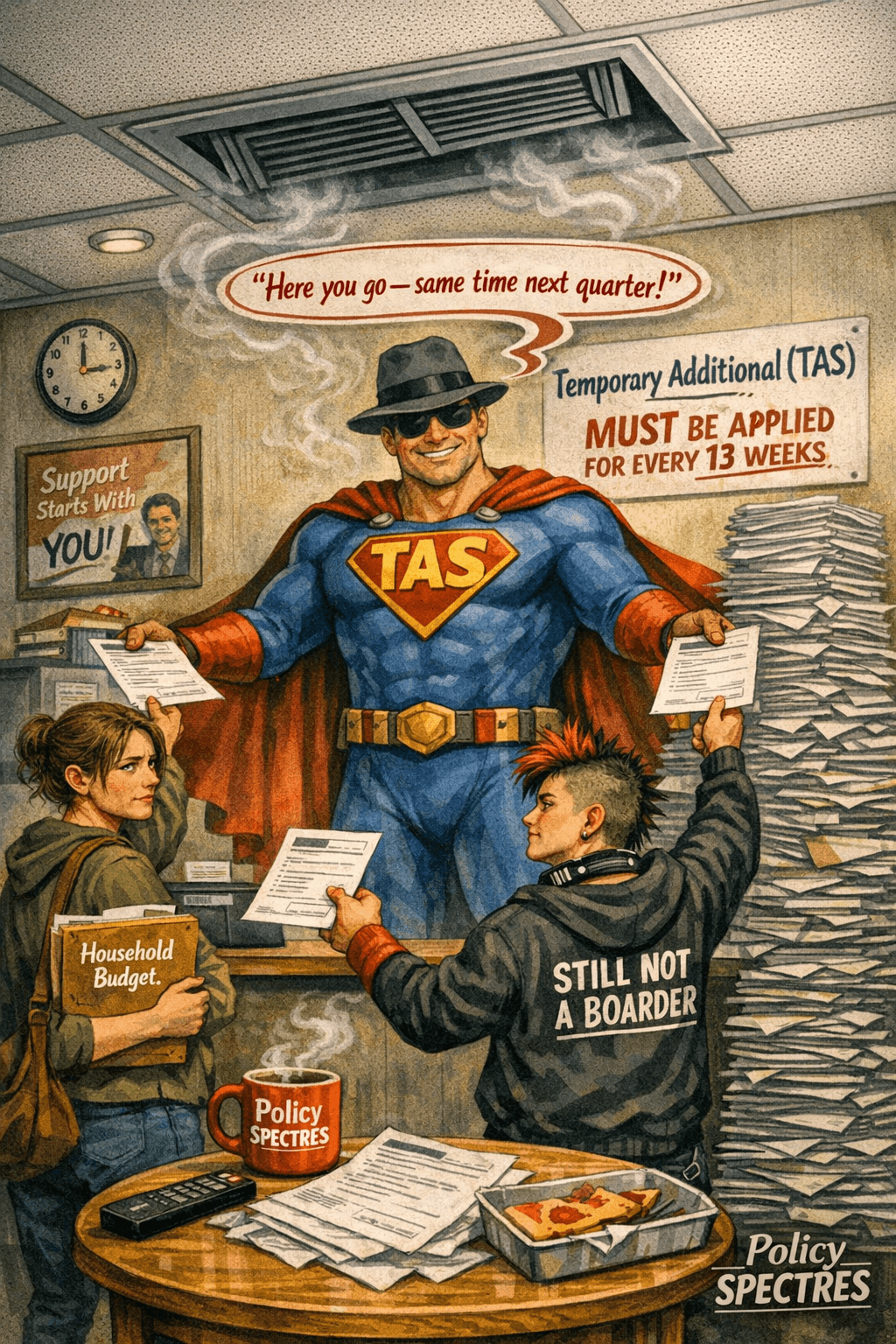
Enter TAS (Temporary Additional Support), wearing a cape made of paperwork and a 13‑week countdown timer.
TAS steps onto the stage and announces:
The most inefficient, expensive, labour‑intensive support product in the entire welfare system takes a bow.
🧩 Act VII: Family Interference Specialty
Nothing delights MSD quite like forcing a family to choose whose benefit gets cut.
Once MSD reclassifies a family member as a “renter,” “non‑boarder,” or “family contribution,” the next question isn’t:
• What’s fair?
• What’s accurate?
• What reflects reality?
No — the next question is:
Parent or child?
Homeowner or dependent?
Who absorbs the shortfall?
Who gets pushed into TAS?
Who carries the administrative burden?
MSD inserts itself directly into the family dynamic — uninvited — and forces households to negotiate over who gets punished.
It’s the bureaucratic equivalent of handing a family a single life jacket and walking away.

🗂️ Act VIII: The Paperwork Avalanche
TAS is time‑limited.
It expires every 13 weeks.
It must be reapplied for.
It must be reassessed.
It must be re‑documented.
So even though only tens of thousands of people are on TAS at any given time, MSD ends up processing hundreds of thousands of TAS applications a year.
And when MSD rewrites a definition and pushes thousands more people off Accommodation Supplement and into TAS?
What’s another 50,000 applications a year.
MSD already processes something like 200,000 TAS renewals and reviews — what’s a little more paperwork between taxpayers.
It’s churn by design.
📄 Act IX: Bonus Paperwork
MSD’s Favourite Loyalty Programme
Accommodation Supplement is simple:
You apply once.
You update if something changes.
But TAS?
TAS is MSD’s paperwork loyalty programme, where the reward for needing help is… more paperwork.
Because TAS expires every 13 weeks, every person forced off AS and into TAS must now:
• reapply
• re‑prove
• re‑document
• re‑justify
• re‑submit
• re‑wait
Four times a year.
So instead of:
• one application
• stable support
• predictable cost
We now get:
• four TAS applications per person per year
• quadruple the paperwork
• quadruple the staff time
• quadruple the administrative cost
And the logic behind it?
Apparently accommodation is the area we could afford to cut back on — what with all those empty houses lying around.
It’s honestly a horror‑comedy in the making.
This is Kafka with a clipboard.
Kafka with a calculator.
Kafka with a 13‑week review cycle.
📰 Act X: The Budget Nobody Questioned
When the Budget dropped, every expert, commentator, journalist, and political observer pored over the headline numbers.
But did anyone ask:
“How will this new boarder definition actually be implemented?”
No.
Not a whisper.
Not a headline.
Not a panel discussion.
Not a single operational question.
Just a tiny Treasury footnote, barely visible.
Nine months later, we’re living the consequences:
• thousands pushed off Accommodation Supplement
• thousands forced into TAS
• four times the paperwork
• four times the admin cost
• families forced to choose whose benefit gets cut
• hundreds of thousands stripped from the people who need help the most
All because nobody asked:
“What happens when this hits real households?”
🧾 Act XI: The Budget Vague‑ness Vortex
People like to imagine Budgets as tidy, precise documents.
But that’s the fantasy.
The reality?
Budgets are vague on purpose.
And in New Zealand, that vagueness becomes something far more dangerous:
A licence for an agency handling $32 billion a year — with no financial regulation — to invent its own definitions.
The Budget didn’t say:
• how the rule should be implemented
• how it aligned with IRD
• how it aligned with tenancy law
• how it aligned with banking standards
• how it aligned with reality
It simply dropped a line of text and walked away.
And because MSD is unregulated financially, it could turn that vague line into:
• a new definition
• a new rule
• a new operational reality
• a new crisis
This isn’t just a policy failure.
It’s a governance failure.
It’s what happens when:
• a Budget is vague
• an agency is unregulated
• definitions are invented
• scrutiny is absent
• and the public only discovers the consequences when the letters arrive
It’s not tidy.
It’s not transparent.
It’s not accountable.
It’s Kafka with a calculator and a rubber stamp.

🧨 Act XII: The Punchline That Isn’t a Joke
And the most absurd part?
It’s actually true.
The same accommodation money still needs to be paid.
The same households still need support.
The same rent still exists.
But because MSD rewrote a definition, the system now delivers the exact same money through a process that costs four times as much to administer — and nobody is questioning it.
It’s comical in its absurdity — until you remember it’s real.
🧮 Act XIII: The Budgeting Irony
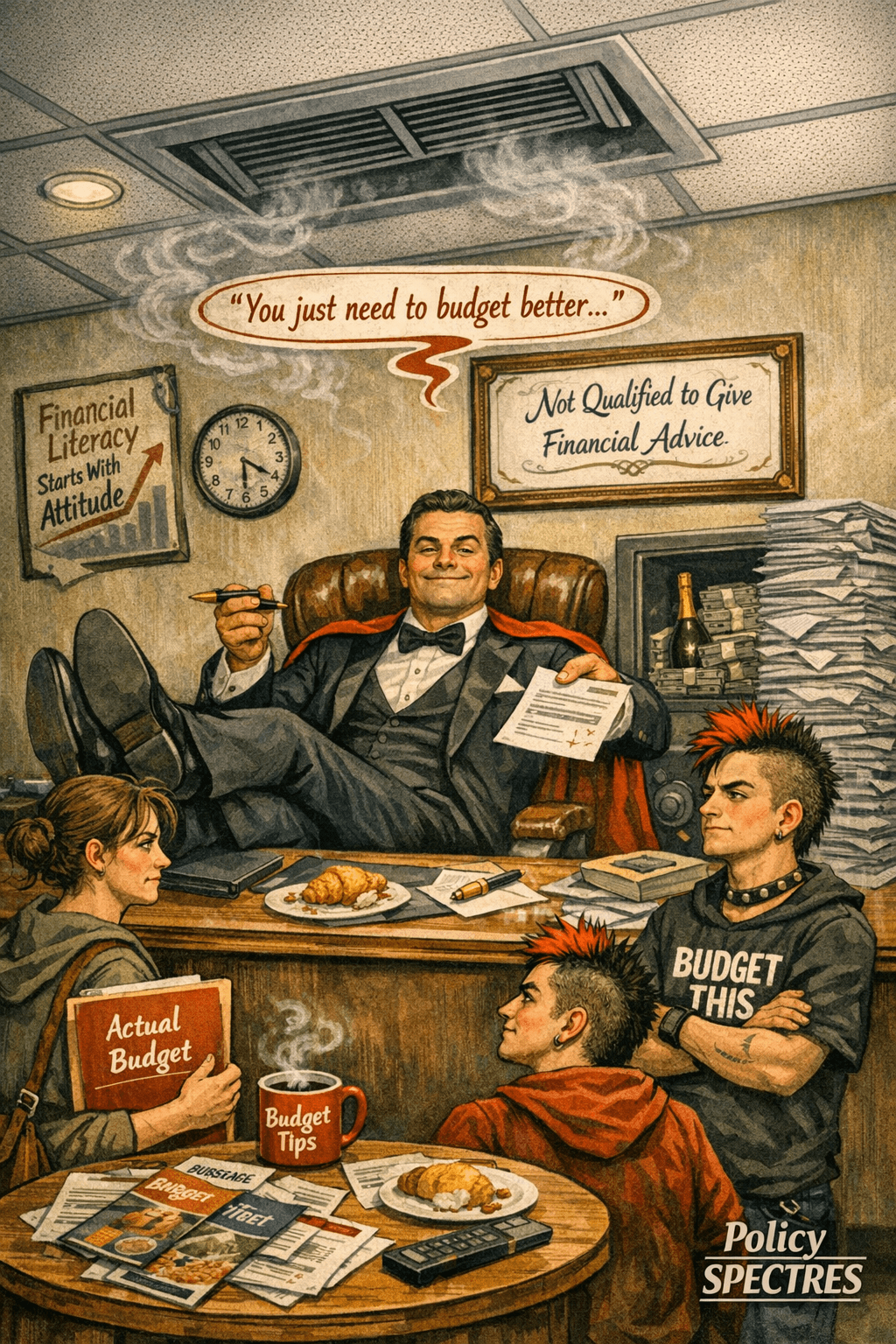
Beneficiaries have been lectured for years about budgeting.
But the agency delivering those lectures has designed a system that:
• quadruples its own workload
• quadruples its own processing cost
• quadruples its own staff time
• quadruples its own inefficiency
…for no increase in public value.
The people being judged for “poor budgeting” are being managed by an agency that:
• isn’t financially regulated
• contradicts IRD
• contradicts tenancy law
• contradicts banking standards
• and just invented a rule that quadruples its own operating cost
If this were a private company, the board would be in flames.
🧨 Act XIV: The $32 Billion Question
Because this isn’t small money.
This isn’t a rounding error.
This isn’t a minor administrative quirk.
This is a $32 billion system.
And when you break that down across New Zealand’s population — roughly 5.2 million people — it works out to:
about $6,150 per person, every single year.
Add in the $2 billion it costs just to run MSD itself and the real figure climbs to:
over $6,500 per person, per year.
Every man, woman, child, baby, retiree, student, worker — everyone.
That’s the scale of what’s at stake.
A system handling that much money should be:
• financially regulated
• operationally aligned
• transparent
• accountable
• consistent with IRD, tenancy law, and banking standards
• and incapable of quadrupling its own workload for no public benefit
Instead, we have:
• vague Budget lines
• invented definitions
• no financial regulation
• no external standards
• no scrutiny
• no alignment
• and a system that can quietly rewrite reality and quadruple its own admin cost without anyone blinking
And the part that should worry every taxpayer, policymaker, journalist, and voter?
There is $32 billion taxpayers money at stake every year — and we should be very, very worried.
🧱 Final Line
After all that — the definitions, the paperwork, the churn, the cost blowout, the governance vacuum, the budgeting irony, the Kafka‑esque logic spiral, the $32Billion at stake…
Are you banging your head against the wall yet — because successive governments have allowed it.
Bought to you by MOV ITx — we move it, prove it, then multiply it.
These are the voyages of Random Circuits, boldly entering the arena of ideas that disrupt, challenge, and transform.