
Sport in Aotearoa — Where Rugby Is Religion, Rivalry Is Friendly, and Everyone’s Welcome on the Sideline. Sport in New Zealand isn’t a hobby. It’s not something you “fit in if you have time.”
It’s a national identity, a community glue, and a weekend operating system that every Kiwi quietly signs up for.
And at the centre of it all is one truth:
In New Zealand, “football” means rugby.
Don’t bother arguing the “foot + ball” logic. We’ve heard it. We don’t care.
Rugby is the national sport, the national mood ring, and the national religion.
We’ll politely respect your opinion — and then continue calling rugby “football” anyway.
The Australia Clause — Friendly Rivalry, Never Hostile
New Zealanders love every nation.We welcome every team.
We respect every sport.
But there is one unspoken, gently comedic rule:
Don’t support Australia.
Not in rugby. Not when we’re playing them.
Not when there’s a trophy on the line.
And definitely not when losing means you’re buying the beers.
It’s not hatred.It’s sibling rivalry — the kind where you’ll tease each other endlessly but still lend them your lawnmower.
If You Do Support Australia… Expect Stick (banter)
You’re not in trouble. You’re not being judged.
But you will get stick (banter):
- “Gone to the dark side, have you.”
- “Didn’t know we had an Aussie in the room.”
- “Hope you’re buying the beers if they lose.”
It’s affectionate, relentless, and very Kiwi.
And Yes — The Same Rules Apply in Australia
Everything we do to Aussie supporters here? They do right back to us over there.
If you’re a Kiwi supporter in Australia, you’ll get:
- ribbed
- teased
- questioned
- mocked
- challenged
- and occasionally applauded
All with the same grin, the same tone, the same banter.
It’s mutual. It’s expected. It’s the trans‑Tasman way.
Underneath it all, both sides know:
- we respect their skills
- they respect ours
- we hate losing to each other
- but we love the contest
and we’d rather lose to each other than to anyone else
The “If Australia Has the Trophy, We’re Coming For It” Rule
There is one more unspoken truth:
If Australia wins a World Cup or major trophy, New Zealand immediately begins plotting how to take it off them.
It doesn’t matter what the sport is.It doesn’t matter if we cared about it yesterday.
If Australia has it, we want it.
And we want to win it off them, specifically.
Because nothing motivates New Zealand quite like Australia holding a trophy we want.
The “Bigger Doesn’t Mean Better” Rule
Australia is bigger. Australia is louder. Australia has more people, more money, more stadiums, more everything.
But that does NOT mean they’re better.
And New Zealanders see it as our personal responsibility to keep them grounded — kindly, cheekily, and consistently.
We like our trophy cabinets full.
And the best trophies are the ones we win off Australia
If we have more trophies than them, we will absolutely talk about it. At BBQs.
At work. At school pick‑up. Anywhere.
It’s tradition.

The Armchair Critic — A National Sporting Role
No matter the sport, no matter the stakes, no matter the time of day, New Zealand has a guaranteed extra player on the field: the armchair critic.
They appear instantly at any national sports event — rugby, cricket, netball, league, Olympics, you name it — ready to analyse every decision with the confidence of someone who has never once refereed, coached, or even read the rulebook.
Every pass is scrutinised.Every penalty is debated.
Every ref call is either:
- “absolutely correct”
- or “the worst decision in sporting history”
There is no middle ground.
And if the ref doesn’t rule in our favour?
We were robbed. Obviously. Blatantly. Outrageously.
The armchair critic is commonly found:
- on the couch
- bowl of chips in one hand
- beer in the other
- yelling tactical advice the players absolutely cannot hear
- insisting they “would’ve scored that” despite not having sprinted since 1998
They are not optional. They are a national institution — as Kiwi as pavlova, jandals, and arguing about whether that was really a forward pass.

The Rugby League Loophole
Rugby league is the one genuine exception:
- If you live outside Auckland → you can support any Australian NRL team
- You can choose a State of Origin side — Blues or Maroons
- You can follow Aussie clubs, Aussie players, Aussie coaches
But if the Kiwis are playing Australia?
You support the Kiwis. No debate.
And if you live in Auckland…
You support the Warriors.It’s not a choice. It’s a lifestyle.
Sport Starts Early — But Universally at Age 5
Some Kiwi kids start sport at 2, but the real universal expectation begins at age 5, when school starts.
By then, every child will:
- be enrolled in at least one sport
- be doing swimming lessons if they live anywhere near a beach
- be expected to be active on weekends
- be part of a team, club, or class activity involving movement
It’s not pressure.It’s not competitive parenting.
It’s simply normal life.
Swimming: A National Expectation, Not a Hobby
In New Zealand, learning to swim isn’t optional — it’s basic survival.
We don’t care how you learn:
- baby swimming
- preschool lessons
- school pools
- surf clubs
- community pools
- grandparents teaching you in the backyard
As long as you can:
- float
- kick
- dog‑paddle
- get yourself to safety
…you’ve met the national standard.
School Sports Culture: Aotearoa’s Built‑In Sporting Ecosystem
Every school — big or small, rural or urban — is set up for sport as a matter of course.
Even the smallest schools have:
- a sports field
- a court for netball or basketball
- a shed or cupboard full of sports gear
- lunchtime equipment kids can check out
- cones, bibs, balls, bats, hoops, ropes
Australia may have similar setups — but in New Zealand, it’s universal.It’s expected.
It’s part of the school identity.
Bigger Schools Have Even More
Modern or larger schools often include:
- an indoor gym
- a multi‑purpose hall that doubles as a sports space
- specialist PE teachers
- proper courts and marked fields
And Back in the Day… School Pools
Many schools used to have their own swimming pools — usually cold, concrete, and slightly questionable — built through endless community fundraising:
- bottle caps
- stickers
- chocolate bars
- raffles
- gala days
- sausage sizzles
Some schools still have them. Some don’t.
But the culture of fundraising for sport is still alive and well.
The Sideline Village — Everyone Is Welcome
Sport in New Zealand is never just about the kids on the field. It’s a community event, and the sideline is open to all:
- grandparents
- aunties
- uncles
- cousins
- neighbours
- visiting family from Australia
- or anyone who just wants to watch
If you’re there, you’re part of the team.
It doesn’t matter if the child is:
- brilliant
- average
- distracted
- picking daisies
- running the wrong way
- or simply “participating”
Participation is celebrated.Effort is applauded.
Every kid gets a cheer.
Because Kiwi sport is about belonging, not perfection.

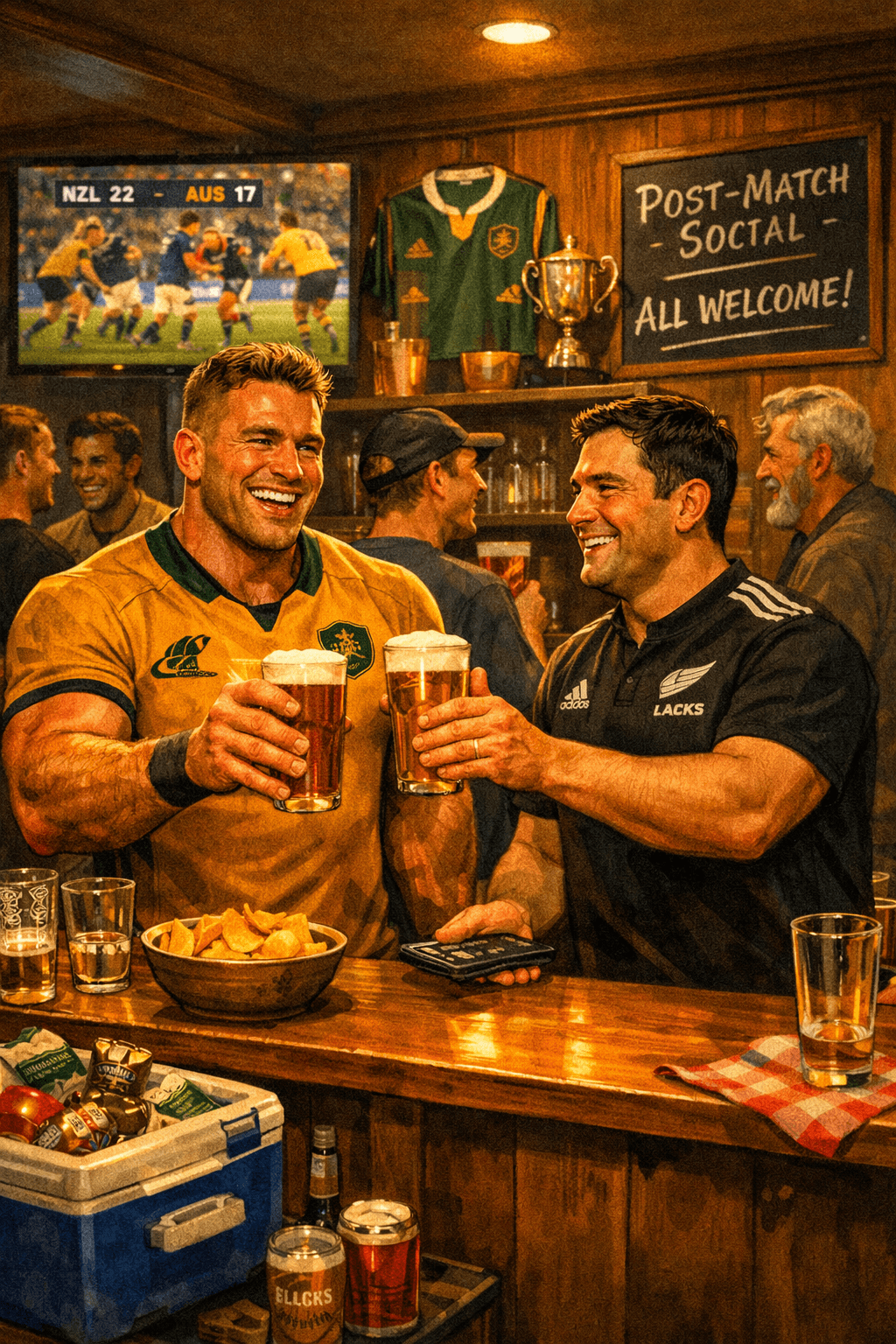
The Post‑Match Social — Where Rivals Become Mates
Unless you’re in an elite squad — or desperately trying to get into one — senior sport in New Zealand has an unspoken rule:
The game isn’t over until the post‑match social.
After the final whistle, everyone heads to:
- the clubrooms
- the local pub
- or whichever venue is closest if the club doesn’t have its own space
This is where the official handshaking ceremony happens — not on the field, but at the bar.
What It Looks Like
You’ll see:
- both teams mixing together
- muddy socks and half‑untucked jerseys
- kids running around the clubrooms
- supporters drifting in
- someone behind the bar who knows everyone’s name
- a mountain of hot chips that disappears instantly
It’s relaxed, friendly, and deeply Kiwi.
Family‑Friendly by Default
Most clubs are:
- family‑friendly
- relaxed
- multi‑generational
- welcoming to anyone who wanders in
Some are licensed.Some are BYO.
Some operate on the “we’ve got a bar but you can bring snacks” system.
But the vibe is always the same:
Everyone belongs — even the opposition.

A Gentle Contrast With the Northern Hemisphere
One thing many Kiwis don’t realise — until they travel — is that our relaxed, everyone‑welcome post‑match culture is not universal.
In parts of the Northern Hemisphere, the rivalry doesn’t stop at the whistle. It stays “on”:
- on the field
- off the field
- in the stands
- and especially in the bars
In some regions, even wearing the opposition colours in the wrong venue can get you:
- refused service
- shouted at
- or unintentionally caught in trouble
Not because people are unfriendly — but because the sporting culture is built differently.The rivalry is fierce, territorial, and constant.
A Kiwi Warning: Stick With Your Tribe
If you’re a Kiwi travelling in the Northern Hemisphere, the safest rule is:
Stick with your tribe.
If there are:
- Kiwis
- Aussies
- or anyone wearing your team’s colours
…then you’re welcome. That’s your group.
That’s your safe zone.
But wandering into a rival pub in full opposition kit— something a Kiwi wouldn’t think twice about at home — can go sideways fast especially in soccer kit (commonly known as football ).
The Kiwi Difference
Back home, the idea of refusing to serve the opposition is almost unthinkable.
In New Zealand:
- the rivalry ends at the whistle
- the bar becomes neutral ground
- the opposition is welcome
- the banter is friendly
- the handshake is genuine
- the chips are shared
- the kids run around together
Even with Australia — especially with Australia — the post‑match social is where rivals become mates.
When the Elite Turn Up — Especially the Aussies
If you’re an international‑level player and your season has just wrapped, you are always welcome at the post‑match social in New Zealand.
We know that at elite level it’s usually:
- protein shakes
- recovery protocols
- ice baths
- physio
- video review
…but when the season is over and the pressure’s off?
The bar door is open.
Campese: The Classic Example
David Campese is the perfect illustration of how Kiwis treat elite rivals.
On the field?
- a threat
- a rival
- a player we loved to beat
- one of the greats when Australia was at its rugby peak
Off the field?
Seen in bars after matches, relaxed, approachable, and widely regarded as a genuinely good guy — even by the fans who spent 80 minutes yelling at him.
He embodies the Kiwi rule:
Booed during the match. Respected afterwards. Always welcome at the bar.
The Only Times You’re Not Allowed to Watch
New Zealand sport is open‑door, all‑welcome, bring‑your‑nan, bring‑your‑cousin‑from‑Australia.
Except for two sacred moments:
1. The national team preparing for a World Cup
2. Team New Zealand preparing for the America’s Cup
These are the only times when:
- the gates close
- the sheds lock
- the tarps go up
- the cameras are banned
- and everything becomes classified
No spectators. No exceptions. Not even for the cousin visiting from Brisbane.
Because in these moments, secrets win trophies.
The Victory Parades — When the Whole Country Turns Up
There are two sporting events that stop the nation:
Winning the Rugby World Cup
Winning the America’s Cup
When either trophy comes home:
- schools stop
- workplaces pause
- parents pull kids out of class
- the streets fill
- the flags come out
- the country unites
The Rugby World Cup Parade
Open‑top buses. Crowds ten deep.
Kids on shoulders.
Grown adults crying.
Aotearoa at its proudest.
The America’s Cup Victory Tour
Boats swarming the harbour. Fans packing the waterfront.
The Cup held aloft like a sacred taonga. Pure Kiwi magic.

The Real Kiwi Weekend: Not Watching Sport —
Driving to It
New Zealanders don’t spend weekends watching sport on TV.
We spend weekends driving our kids to their sport.
Saturday mornings look like:
- muddy boots
- chilly bins
- sideline coffees
- folding chairs
- sunscreen
- whistles
- and a schedule that defies physics
It’s not a hobby.It’s a national operating system.
The Kiwi Parent Contract: You Will Be Volunteered
If your child plays sport in New Zealand, you will — without warning — be roped into:
- refereeing
- coaching
- managing
- scoring
- timekeeping
- transporting half the team
- fundraising
- washing the team jerseys
- bringing the oranges
You don’t sign up. You simply show up once and suddenly:
“You’re on oranges next week.”
It’s community sport.It’s how the country runs.
The Sausage Sizzle — The Sacred End‑of‑Sport Snack
The sausage sizzle is practically a national religion.
It appears at:
- sports games
- prizegivings
- fundraisers
- school fairs
- club days
- Bunnings (obviously)
And the menu is always:
- BBQ sausage
- slice of white bread
- tomato sauce
If you’re fancy, you get:
- onions
- mustard
But the core formula is sacred.
Cheap. Cheerful.
Community.
The taste of Kiwi childhood.
Why New Zealand Punches Above Its Weight
Because from age five onward, every Kiwi is:
- active
- involved
- part of a team
- part of a community
- learning resilience
- learning to win
- learning to lose
- learning to show up
- learning to try again next week
It’s not about creating elite athletes. It’s about creating New Zealanders.

These are the voyages of Random Circuits, boldly entering the arena of ideas that disrupt, challenge, and transform.