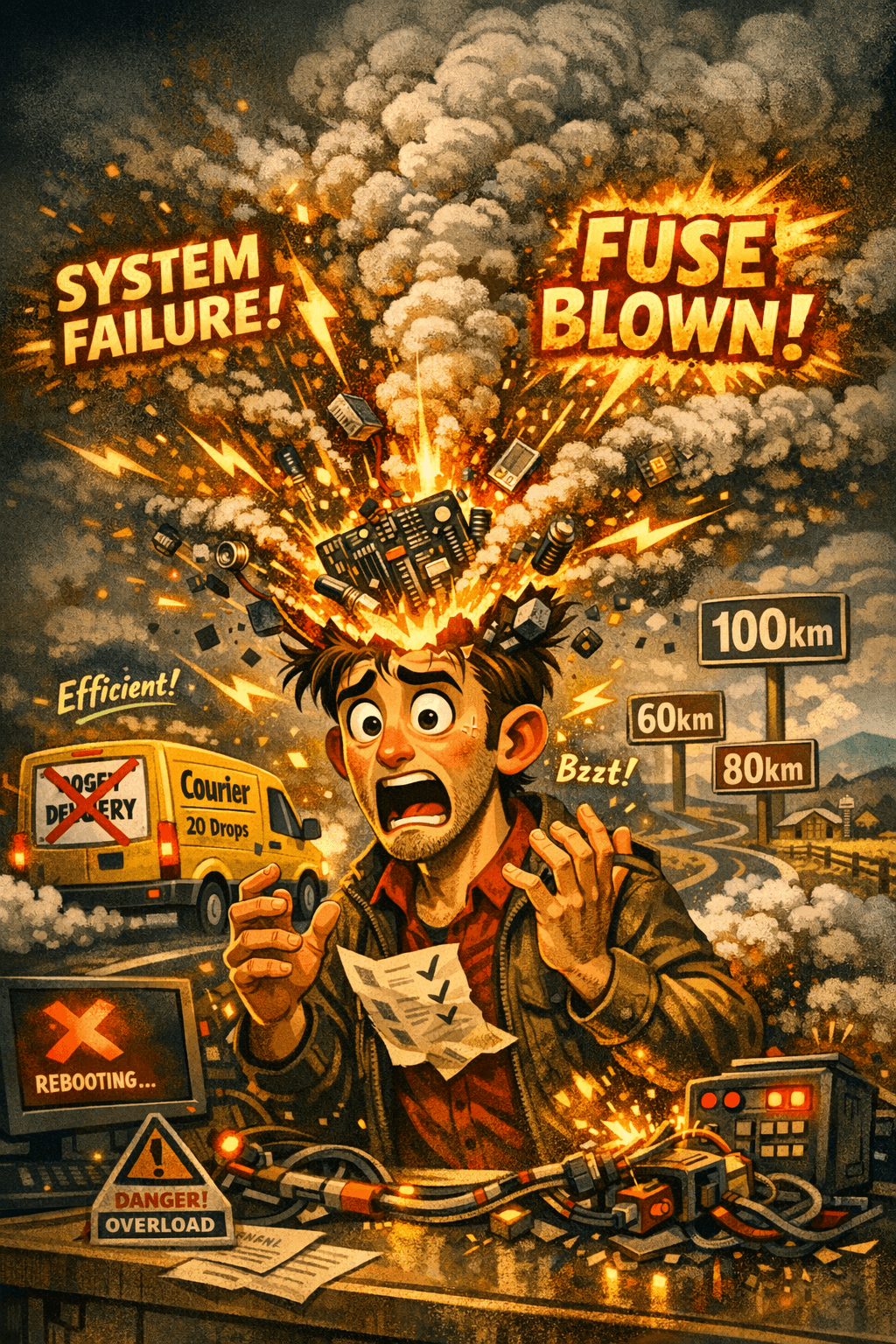
This piece maps the moment my brain short‑circuited trying to reconcile a national fuel crunch with an MSD process that requires multiple car trips to avoid a $10 delivery fee. It’s a look at the hidden fuel costs baked into a system that hasn’t updated itself in decades.
There are days when MSD logic hits my brain so hard that something inside me just… sparks. Today’s short circuit was brought to you by a simple question:
“Why am I doing a 30km round trip — twice — in the middle of a fuel crisis?”
Because apparently, in MSD‑land, fuel is imaginary, time is infinite, parking is free, and delivery is a luxury reserved for people who don’t need it.
Meanwhile, the rest of the country is literally counting its days of petrol and talking about public transport like it’s going to magically appear in rural New Zealand.
And yet the single easiest thing to change — delivery — is the one thing they refuse to cover.

🔥The 30km Problem
(aka: My Brain Has Exploded)
Let’s do the math the way IRD does:
• 30km round trip = $35.10
• Two trips = $70.20
• Parking = $2–$5
• Time = 45–90 minutes per trip
• Opportunity cost = whatever else you could have been doing
Delivery? $6–$12.
So naturally, MSD’s workflow says:
“Please burn $70 in fuel, pay for parking, and lose two hours of your life instead of letting us pay $10 for delivery.”
My brain: bzzt… pop… smoke curls out the vents.

🧩 The MSD Workflow
(aka: The Circuit Board From Hell)
Here’s the actual process:
1. Get a quote from the approved supplier
2. Go to MSD
3. Wait for approval
4. Tell the supplier it’s approved
5. Wait for MSD to pay the supplier
6. Return to the supplier to pick up the item
That’s two to three trips minimum.
And honestly? I’m lucky — I managed to get the quote online, so I only have to do two trips instead of three.
This is not efficiency. This is waste.

🚗 And that’s just me — a suburban person.
If you live in the country?
- 40km → $46.80
- 60km → $70.20
- 80km → $93.60
- 100km → $117.00
And yes, that’s per trip.
Two trips doubles it.
But sure — let’s keep pretending delivery is the expensive option.

💼 Corporate Logic vs MSD Logic
Corporate logic:
“If I could cut your fuel, time, and parking costs by 70–90%, would you consider it?”
MSD logic:
“Please drive 60km to pick up your glasses from our preferred supplier. Twice.”
Corporate logic:
“Delivery is cheaper, greener, faster, and reduces system waste.”
MSD logic:
“Have you tried being on the bones of your arse? It’s very fuel‑efficient.”
🧠 The 10% Scenario
(aka: The Part Where My Brain Fully Detonates)
Let’s say only 10% of MSD clients do this once a year.
MSD supports roughly 300,000+ people at any given time.
10% = 30,000 people.
If each person does a 30km round trip:
• 30km × 30,000 = 900,000 km
• At $1.17/km = $1,053,000 in fuel cost
• And that’s one trip
But the workflow forces at least two trips:
• $2,106,000 in fuel
• 60,000 hours of client time
• 30,000 parking payments
• 30,000 unnecessary emissions events
Delivery for the same 30,000 people?
• $10 × 30,000 = $300,000
So MSD’s current workflow costs seven times more than delivery.
My brain: full meltdown, sparks everywhere, system reboot required.
🌿 And here’s the part that really blows the fuse
The country is literally counting its days of petrol. We’re being told to conserve fuel, use public transport, reduce unnecessary travel.
And yet the people with the least are being put through the most inefficient, fuel‑burning, time‑wasting process imaginable — for no reason other than:
“That’s how we’ve always done it.”
The easiest, cheapest, greenest fix?
Delivery.
The one thing MSD won’t cover

⚡ The 10km Rule
(aka: The Only Sensible Thought in This Whole Circuit)
If the supplier is more than 10km away, delivery should be included. Full stop.
Because:
• it saves fuel
• it saves time
• it saves parking
• it saves stress
• it saves money people need for food or even a coffee
• it saves the country fuel during a national shortage
• it saves MSD money
• it saves the environment
One courier van doing 20 drops uses less fuel than 20 people doing 20 separate round trips.
This is not radical. This is math.
⚡ Conclusion: Fuse Blown
This is a diagnostic report from a brain that has just short‑circuited trying to reconcile:
• a fuel crisis
• a cost‑of‑living crisis
• a delivery system that already exists
• and a government workflow that insists on burning fuel like it’s 1998
Random Circuit complete. Smoke cleared. System rebooting
Bought to you by MOV ITx — we move it, prove it, then multiply it.
These are the voyages of Random Circuits, boldly entering the arena of ideas that disrupt, challenge, and transform.