
Opportunity favours the brave — so is New Zealand going to step forward, or keep passing the hesitation around like a bad midfield. Football has delivered crowds, trophies, global attention, and multi‑million‑dollar Kiwi deals, yet the nation’s biggest city still can’t give the world’s biggest sport a home. Seven billion eyes watch FIFA. Thousands of kids choose football every weekend. Auckland Knights just took a trophy off Australia. If that’s not a national challenge, what is.
New Zealand loves sport. We breathe it, argue about it, raise our kids in it.
But somehow, in the biggest city in the country, soccer still has no home.
And you have to ask — why the hesitation?
Auckland football club just took a trophy off Australia. League hasn’t managed that yet.
Rugby has done it for decades — but it wasn’t always that way. Every fortress starts somewhere.
Thousands of girls and boys play soccer.Not all are built for rugby or league.
And football doesn’t care what shape you are.
You can be 1.83m like Ronaldo the billion dollar man or 1.7m like Messi, also considered one of the greatest ever, neither from wealthy families and still compete to be the best in the world — without being left like an imprint in the ground.

The most popular sport on Earth. The most accessible. The most global.
And New Zealand’s biggest city can’t give it a home?
Seven billion eyes were on FIFA.Seven. Billion.
Is that really a market New Zealand wants to neglect?
We just watched what football can do.Crowds. Atmosphere. Families. Noise. Colour. Energy.
We just watched a young Kiwi sign multi‑million‑dollar deals, proving football isn’t a dream here — it’s a pipeline waiting to be built.
If that’s not a challenge to tribal sports thinking, then what is.
And let’s be honest about something people rarely say out loud:
In the UK, soccer is the working man’s sport and opportunity. Rugby is the posh one.
League is dominated by Australia — we accept that challenge without blinking.
But soccer?
Soccer, with global reach, global money, global pathways? That’s the one we hesitate on.
Why?
Why is soccer in the biggest city in the country still borrowing stadiums. Why are major artists skipping Auckland? Why are fans flying to Australia — six extra planes of people to Taylor Swift alone — sending money offshore, making Australia richer while we stay home and watch clips online.
Why is soccer still treated like a guest in this country.
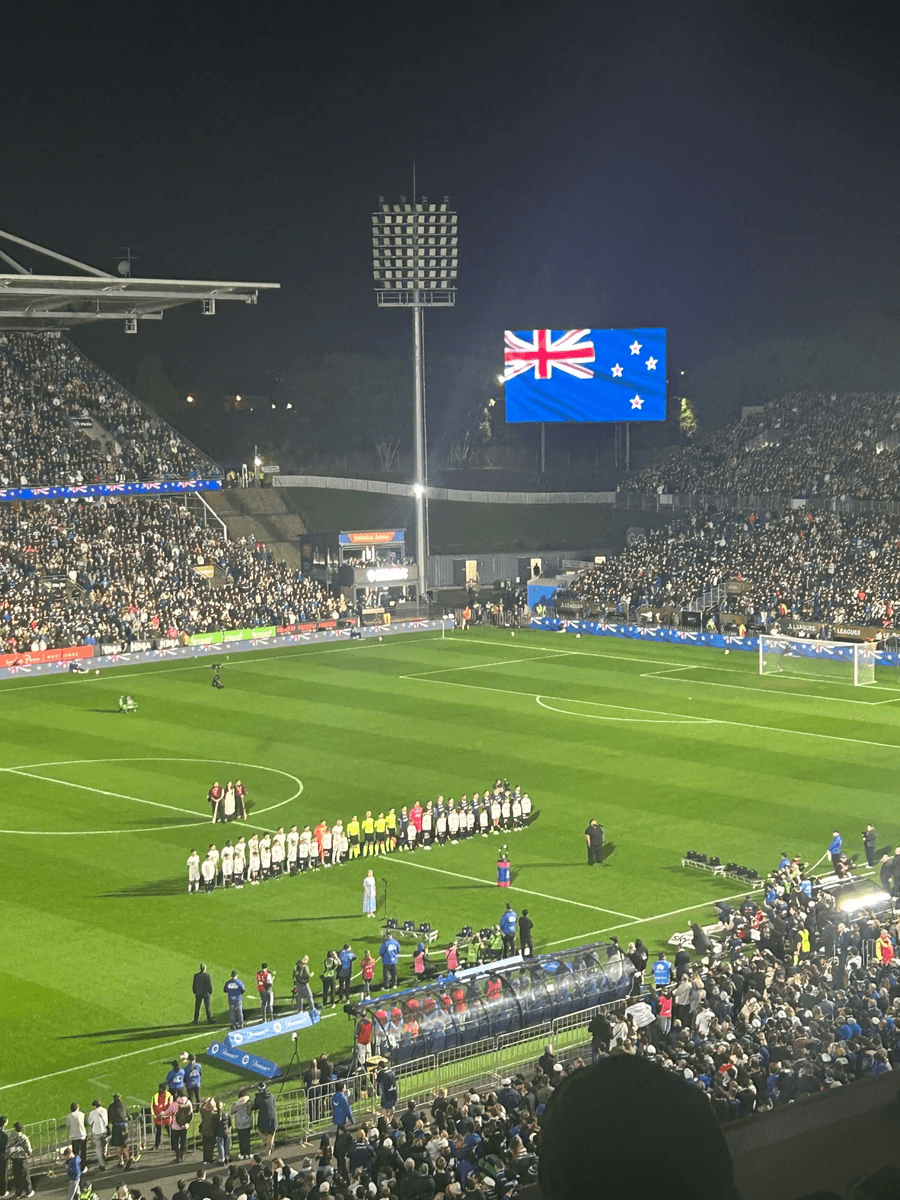
While New Zealand stays tribal in sport, and it’s costing us. We argue code against code like it’s still 1985, instead of recognising that every sport brings something different to the country.
Soccer just produced a young Kiwi signing million‑dollar contracts overseas, yet it’s still pushed to the side as if success in one code threatens another. It doesn’t. I’ve never played rugby, but I’ve watched it live. Same with league. Same with soccer, which I played socially. Watching athletes at their best — in any code — is an opportunity, not something to be dismissed.
None of these sports cancel each other out; they strengthen the country in different ways. Rugby keeps its fortress. League keeps its following. Soccer is simply asking for a home. Music is asking for a venue. And New Zealand is being asked whether it can grow past tribal thinking long enough to build something that serves everyone.
And here’s the part that hits hardest:
It doesn’t need a 5‑year analysis. It needs a proven stadium design that already exists.
There are stadiums in climates just like ours — wet, windy, coastal, seismic — and their designs are sitting right there, ready to be licensed, copied, adapted.Identity doesn’t come from bespoke architecture.

Copy the structure. Adapt the interior. Respect the culture. Don’t redesign the wheel.
Don’t blow the budget trying to impress architects.
Atmosphere comes from people — not concrete curves.
And yes — it could be built in under 5 years if we actually wanted it.And yes — it could be profitable in under 20, something the next generation would benefit from more than we ever will.
Rugby can keep its home.League can keep its home.
Neither needs to be closed.
And when the crowds demand it, they might even borrow football’s new home — because that’s what growing cities do.
But the venue has to exist first.The precinct comes later. Phase 1 is the stadium.
Phase 2 is everything around it.
And here’s the part people keep missing:
When Auckland thrives, New Zealand thrives.Denying Auckland isn’t protecting the rest of the country — it’s holding it back.And a stadium like this could become a precedent for other cities that are growing too.
So maybe the real question isn’t about engineering or cost or committees.
Maybe it’s this:
Do you want it to exist — or do you just want to talk and dream about it.
Because the challenge has been placed on the ground now. It’s sitting right there, waiting.
Your move.

These are the voyages of Random Circuits, boldly entering the arena of ideas that disrupt, challenge, and transform.